 Any / overcast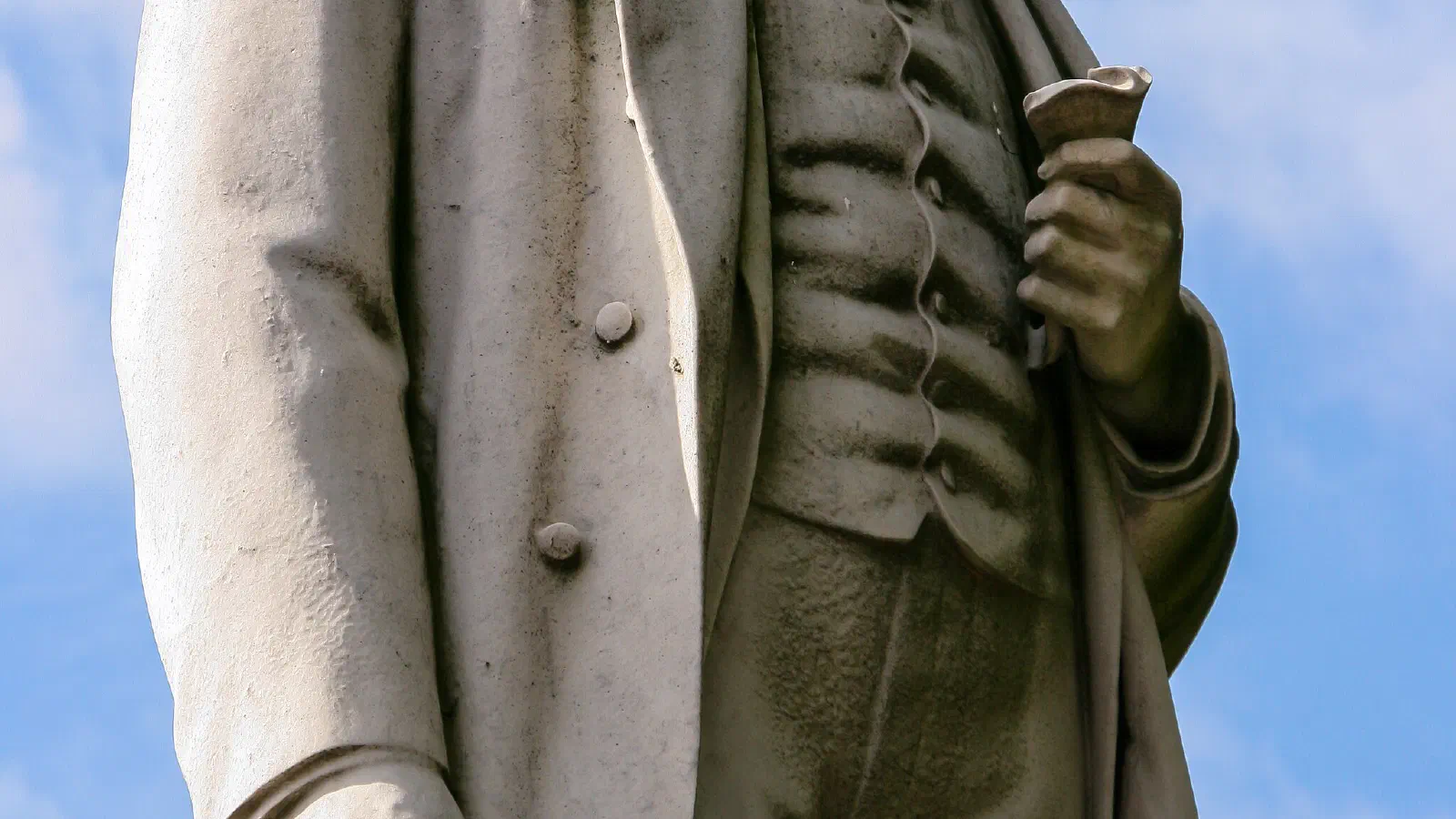
Best at blue hour
Albert Square
City Centre · Manchester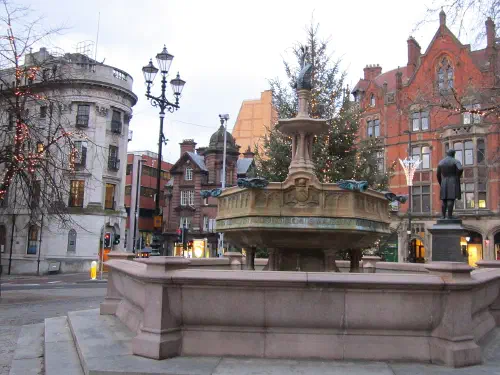
Some gear links on this page are affiliate links — if you buy through them we may earn a small commission at no extra cost to you. See our affiliate disclosure.
What is Albert Square
Albert Square is Manchester’s grandest civic space, laid out between 1863 and 1867 to accommodate the memorial to Prince Albert, consort of Queen Victoria. It replaced a dense residential and industrial district — over 100 buildings were cleared, funded partly by public subscription — to create a formal setting worthy of the city’s Victorian confidence.
At its centre stands the Albert Memorial, designed by Thomas Worthington and sculpted by Matthew Noble: a Gothic canopy sheltering a marble statue of Prince Albert, with symbolic figures representing art, science, commerce and agriculture. Looming over everything is Manchester Town Hall, Alfred Waterhouse’s Victorian Gothic masterpiece, completed in 1877, with a clock tower rising 280 ft and interior murals by Ford Madox Brown. Other heritage buildings include the Memorial Hall (Venetian Gothic, Grade II*, also by Worthington), statues of John Bright, Oliver Heywood and Bishop Fraser, and the Jubilee Fountain.
The square spent years behind hoardings as part of the Our Town Hall restoration project, but it largely reopened in late 2025, in time to host the city’s Christmas programme for the first time since 2019. The remodelled square is pedestrianised on three sides and roughly 25 per cent larger than before, giving photographers cleaner sightlines and far more room to work. The Town Hall building itself remains under restoration, with completion targeted for spring 2027 — the 150th anniversary of its opening.
Why Shoot Here?
Albert Square is a photographer’s playground, offering a blend of architectural drama, historic detail and civic atmosphere:
- Grand architecture: The neo-Gothic Town Hall and ornate memorial offer stunning symmetry, carved stone detail and towering forms — ideal for wide-angle architectural work. With sections of scaffolding now down, the restored stonework photographs better than it has in decades.
- Monumental features: The Albert Memorial, with its canopy, pinnacles and allegorical figures, works at every focal length — full-frame environmental shots and tight 200 mm details alike.
- A bigger, cleaner stage: Pedestrianisation on three sides means fewer parked cars, taxis and street clutter in your frame than the pre-restoration square ever allowed. Only the eastern edge, where the Metrolink line runs, still carries traffic.
- What to look for: Try low-angle framing to accentuate the clock tower’s height, capture reflections on the paving when wet, or shoot through the perimeter trees for depth and context.
- Seasonal variety: In November and December the square becomes the centrepiece of Manchester’s Christmas events — lights, stalls and crowds that suit a completely different, documentary style of shooting.
- Street and event photography: Public gatherings, parades, protests and festivals animate the space year-round — our street photography guide covers the approach.
Getting There
The nearest tram stop is St Peter’s Square, two minutes’ walk away: exit beside Central Library and walk up Mount Street, and the square opens out in front of the Town Hall. By car, NCP Spinningfields or NCP Great Northern both cost around £8–12 per day and are five to ten minutes’ walk. On foot from Piccadilly Gardens, head down Princess Street and the clock tower appears ahead within ten minutes. It pairs naturally with St Peter’s Square and the Central Library interior for a compact half-day architecture shoot.
Photography FAQ
Is Albert Square open again?
Yes. After six years behind hoardings, Albert Square largely reopened in late 2025 as the centrepiece of the city’s Christmas events. It is pedestrianised on three sides and around 25 per cent bigger, so most classic viewpoints are available again.
When will Manchester Town Hall reopen?
The Town Hall is due to reopen in spring 2027, timed to mark the 150th anniversary of the building’s 1877 opening. Until then the interior is closed, but with sections of scaffolding and the temporary roof already removed, the restored exterior and clock tower are increasingly photographable from the square.
What is the statue in Albert Square?
The central monument is the Albert Memorial — a marble statue of Prince Albert by Matthew Noble beneath an ornate Gothic canopy designed by Thomas Worthington, conserved as part of the Our Town Hall works. Statues of John Bright, Oliver Heywood and Bishop Fraser stand around the square’s edges.
Is Albert Square free to visit?
Yes — it is a fully public square with no entry fee, accessible at all hours. Tripods are generally no problem outside major events; during the Christmas season expect dense crowds and plan to shoot handheld at higher ISOs.
When is the best time to photograph Albert Square?
Early morning, before 08:30, gives soft light and an empty square; just after rain is the other prime window, when wet paving mirrors the Town Hall façade. For warm stone tones, time your visit using our golden hour guide.
Further Information
- Wikipedia – Albert Square, Manchester – comprehensive history, monuments and listed buildings
- Manchester Town Hall – Wikipedia – architectural details, history and restoration status
- Manchester City Council – Our Town Hall – official project updates, reopening timeline and Albert Square plans
- World City Trail: Discover Manchester Albert Square – visitor insight and photographic appeal
Best Times to Shoot
- Early morning (07:00–08:30) delivers soft, low-angled light across the Town Hall façade and an almost deserted square — perfect for clean architectural images.
- Golden hour (sunset) paints warm tones on the sandstone clock tower and memorial, with long shadows adding depth and drama.
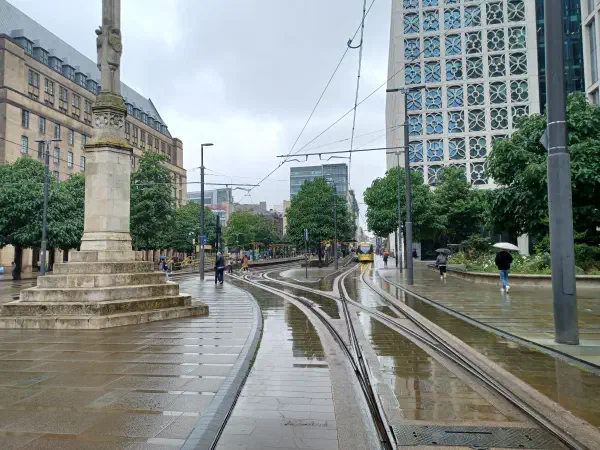
- After rain the wet paving acts as a giant reflector, mirroring the Town Hall and memorial — ideal for symmetrical reflection shots. Keep a dry cloth to hand: the same drizzle that makes the mirror puts droplets on your front element, and you won’t see them until the symmetry is ruined at home.
- Christmas season (November–December) brings lights, stalls and atmospheric crowds back to the reopened square, best captured at blue hour when ambient and artificial light balance.
Composition Ideas
- Low-angle upward shots from the base of the Albert Memorial exaggerate the Gothic canopy’s height against the sky, especially effective with a 16–24 mm wide-angle.
- Symmetrical framing: Stand centrally on the south side of the square and use the memorial as a leading element towards the Town Hall clock tower behind it.
- Detail close-ups: Isolate the carved allegorical figures on the memorial or the Gothic stone motifs with a 70–200 mm telephoto for texture-rich abstracts.
- Tram motion blur: From the western side at dusk, a half-second exposure turns a passing Metrolink tram on the eastern edge into a streak of light beneath the static Gothic façades — something compact like the Peak Design Travel Tripod keeps the façades pin-sharp while the tram streaks; setup technique for the square’s uneven paving is in our blue hour tripod guide.
- Frame through trees on the square’s perimeter to add foreground depth and guide the viewer’s eye into the scene — then continue two minutes west to the John Rylands Library for more Victorian Gothic.
How to shoot it
Lens
A 16–35mm wide exaggerates scale and verticals; a 24–70mm keeps proportions natural. A tilt-shift tames converging lines.
Settings
f/8–f/11 for front-to-back sharpness, ISO 100, and meter for the highlights so detail in the stonework holds.
Composition
Hunt for symmetry and repetition, keep verticals straight, and use doorways or arches to frame the subject.
Timing
Blue hour — the ~20 minutes after sunset — is the sweet spot: the sky balances with the city's lights. Be set up before it starts; today's window is on this page.
More in City Centre
See the area →Nearby spots
Shooting the whole area? Read the City Centre photography guide — every spot, the light that suits it, and a route to link them.