 Golden hour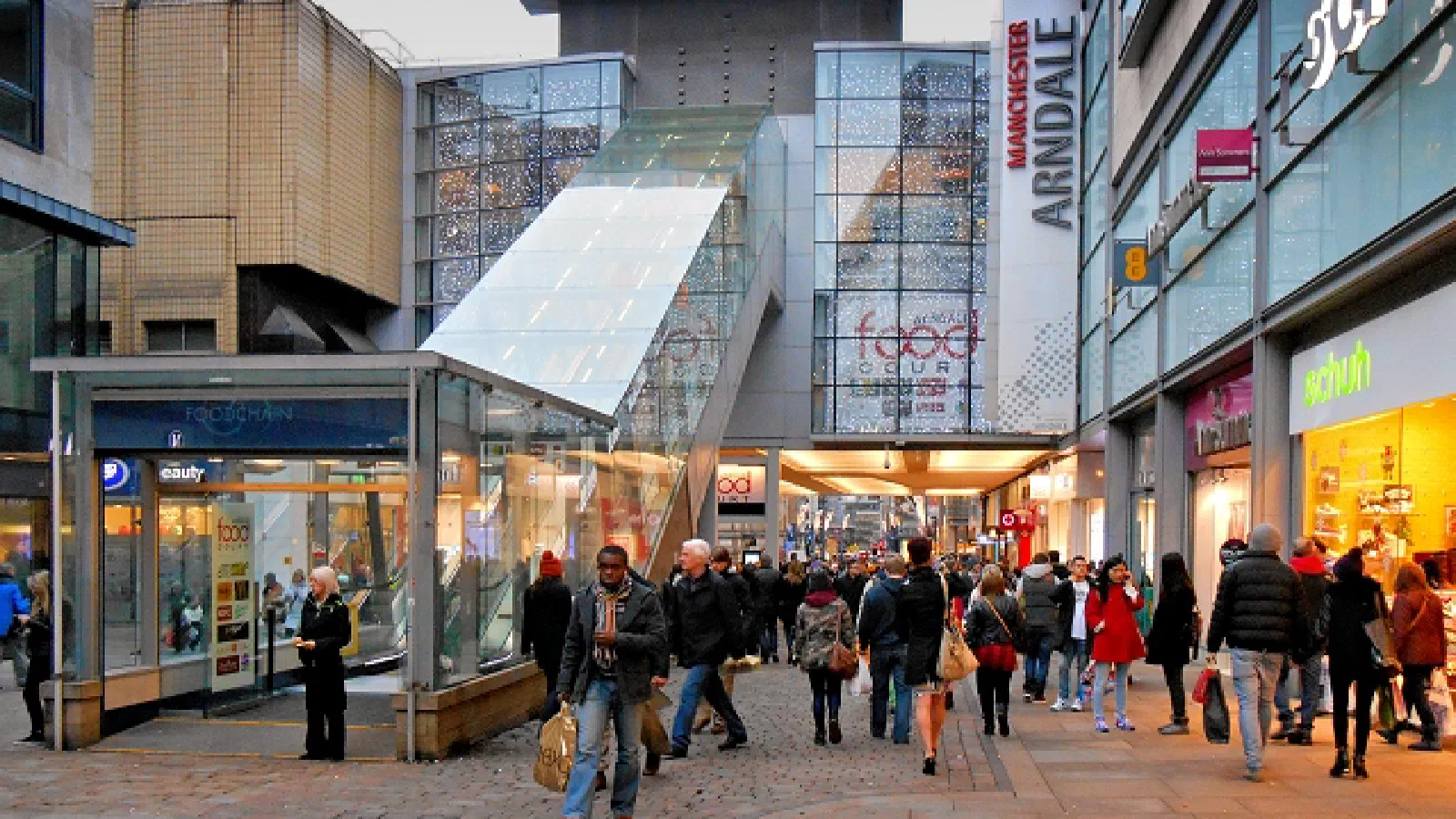
Best at any / overcast
Arndale Food Market
City Centre · ManchesterSome gear links on this page are affiliate links — if you buy through them we may earn a small commission at no extra cost to you. See our affiliate disclosure.
What is Arndale Food Market?
The Arndale Food Market is an indoor market hall on the High Street side of the Manchester Arndale, one of the UK’s largest city-centre shopping complexes. It was redesigned and reopened in 2006 as part of the centre’s post-bombing expansion and redevelopment (Wikipedia – Manchester Arndale), and you can enter it either directly from High Street — facing the edge of the Northern Quarter — or from inside the centre through the Wintergarden. Don’t confuse it with the Arndale’s separate fast-food court on the upper mall: the market hall is the one with independent traders.
The market is home to over 50 independent traders, mixing fresh produce — fruit and veg, meat, fish, baked goods — with international street-food counters. It has built a reputation as one of the cheapest places in central Manchester to eat genuinely well, with stalls serving Mexican tacos, Greek gyros, Caribbean curries, Asian dumplings, bubble tea and more, eaten at communal tables in the middle of the hall.
For photographers, it’s the closest thing the city centre has to a working market atmosphere: steam, queues, handwritten price signs, vendors calling orders — all under one roof, two minutes from Market Street.
Why Shoot Here?
- Food close-ups on tap: Dozens of cuisines plated within metres of each other means colour, steam and texture without travelling between venues. Few locations offer this much food-photography variety per square metre.
- Candid market life: Vendors cooking to order, regulars queuing, communal tables filling at lunch — the hall delivers the kind of human activity that street photographers normally have to wait around for.
- Texture and detail everywhere: Stacked produce, glossy pastries, neon menu boards, hanging signage and handwritten specials make strong fillers for a detail-driven photo essay.
- Weather-proof: Fully indoor and consistently lit, it earns its place on any rainy-day Manchester shortlist — pair it with Afflecks over the road for a full wet-weather shoot.
Getting There
The Market Street and Exchange Square tram stops are each about two minutes away on foot. From Piccadilly Gardens, walk down Market Street and turn right onto High Street; the market entrance is on the Arndale’s eastern flank, opposite the streets leading into the Northern Quarter. Coming from Manchester Cathedral or Exchange Square, cut through the centre via the Wintergarden. Drivers should use NCP Manchester Arndale (~£8–12/day), which connects directly into the centre.
Photography FAQ
Can you take photos in the Arndale Food Market?
The Arndale is privately managed, so photography is at the centre’s discretion — in practice, casual handheld shooting for personal use is generally tolerated. Be discreet, skip the tripod, and ask traders before photographing their stalls or them at work; most are happy if you buy something.
What food is at the Arndale Market?
Over 50 independent traders covering fresh produce, fish, meat and bakery alongside international street food — Mexican, Greek, Caribbean, Chinese, Thai and more, plus bubble tea and dessert counters. It’s known for big portions at low prices.
When is the best time to photograph the market?
Late morning, around 10:30–11:30, for fully stocked, photogenic displays before the rush — then stay into the 12:00–14:00 lunch peak for steam, queues and candid energy. Avoid late afternoon, when displays look depleted and some counters start cleaning down.
Is the Arndale Food Market the same as the Arndale food court?
No. The food court is a separate fast-food floor on the Arndale’s upper mall near Market Street; the Food Market is the independent traders’ hall entered from High Street or the Wintergarden. The market is the photogenic one.
What lens should I bring for market photography?
A fast 35 mm prime — the Sony FE 35mm f/1.8 , Canon RF 35mm f/1.8 Macro IS STM , NIKKOR Z 35mm f/1.8 S , or the Fujifilm XF 23mm f/2 R WR on Fujifilm X — or a 50 mm covers most situations: wide enough for stall scenes, fast enough (f/1.8–f/2.8) for the indoor light without pushing ISO too hard. For a similar but more polished food-hall setting, compare Mackie Mayor in the Northern Quarter.
Further Information
- Manchester Arndale – Arndale Market — official listing of stalls and opening times
- Wikipedia – Manchester Arndale — history of the centre and redevelopment
- The Manc – Foodie’s Guide to Arndale Market — highlights of the best stalls and dishes
Best Times to Shoot
- Late morning (10:30–11:30) is ideal — stalls are fully set up with fresh, photogenic displays but the lunchtime rush has not yet arrived, so you can work the aisles without blocking anyone.
- Lunchtime (12:00–14:00) brings the energy: steam rising from grills, vendors plating to order, and animated queues that give candid shots their life. Weekdays draw office workers; Saturdays a broader crowd.
- Artificial lighting means exposure barely changes through the day — expect mixed colour temperatures from the overhead spots and stall signage, so shoot RAW and fix white balance per frame rather than globally.
- Avoid late afternoons, when some stalls begin closing, displays look picked over, and the cleaning-down process replaces the cooking theatre.
Composition Ideas
- Overhead flat-lays — Hold the camera directly above a colourful plate or tray; a 35–50 mm lens at f/2.8 softens the busy counter beneath while the food stays sharp. The communal tables give you space to set the shot up.
- Candid vendor portraits — At 50–85 mm, catch traders mid-action — flipping naan, stirring pots, arranging fruit — with their illuminated signage dissolving into bokeh behind them.
- Wide establishing shots — From the end of an aisle, a 16–24 mm lens takes in the depth of the hall: rows of stalls, hanging signs and browsing crowds receding towards the entrance.
- Steam against dark backgrounds — Position a grill or wok station against a darker stall interior and expose for the highlights; rising steam reads dramatically when backlit by the stall’s own lamps.
- Colour and texture details — Fill the frame with stacked spices, glossy pastries or a neon menu board for abstract detail shots that intercut well with the wider market story — the same approach that works on Tib Street’s shopfronts nearby.
How to shoot it
Lens
A 35mm or 50mm prime is ideal — small, fast and unobtrusive for candid frames and shopfront detail.
Settings
Shutter priority at 1/250s or faster to freeze movement, with Auto ISO so you can keep shooting as the light shifts.
Composition
Work the light and shadow, look for layers and gesture, and let strong shopfront colour or signage carry the frame.
Timing
Bright overcast suits it best — soft, even light with no harsh shadows — so it works at almost any time of day.
More in City Centre
See the area →Nearby spots

Shooting the whole area? Read the City Centre photography guide — every spot, the light that suits it, and a route to link them.