 Night
Night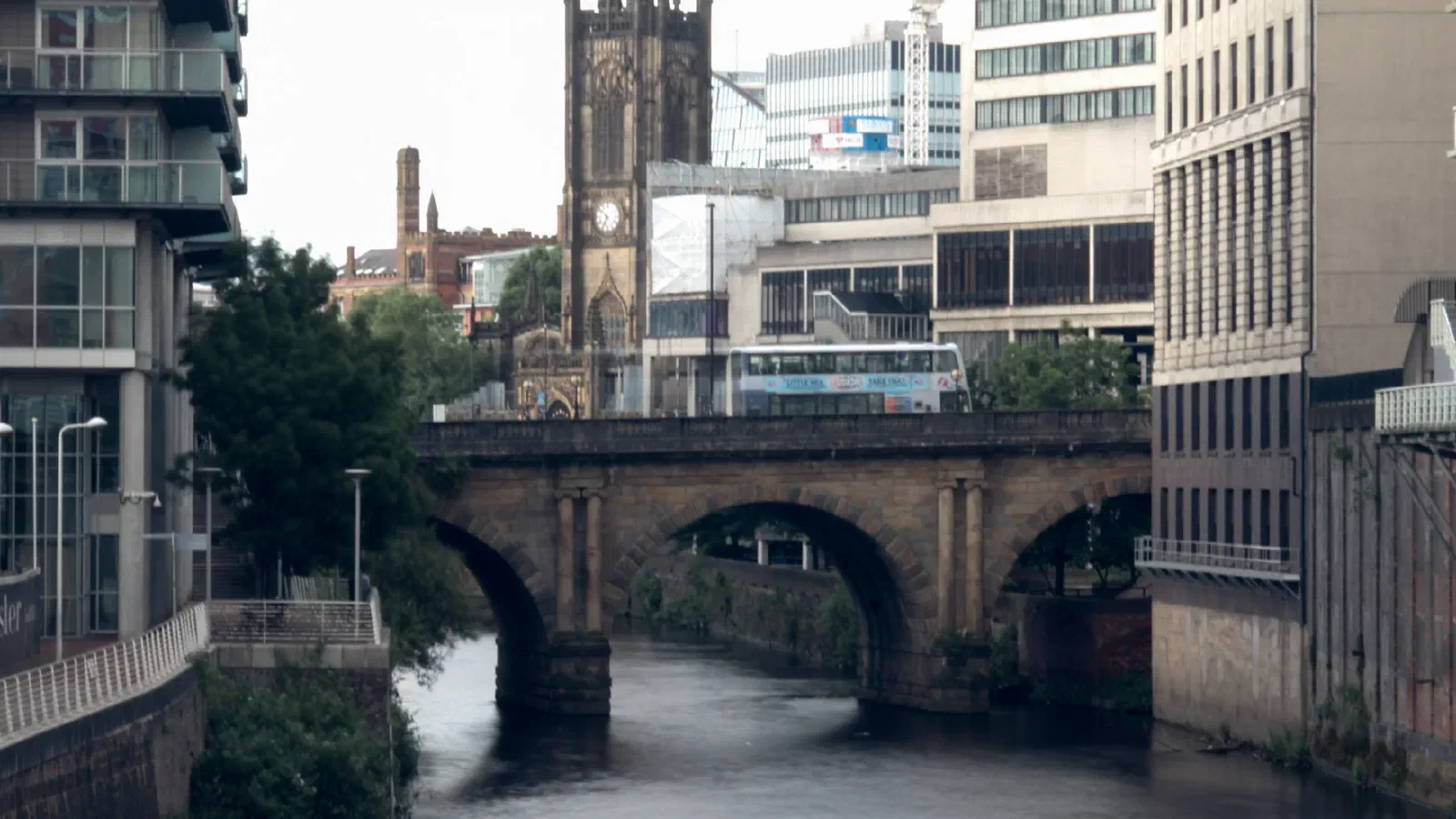
Best at blue hour
Blackfriars Bridge
Greengate · ManchesterSome gear links on this page are affiliate links — if you buy through them we may earn a small commission at no extra cost to you. See our affiliate disclosure.
What is Blackfriars Bridge?
Blackfriars Bridge is a Grade II listed sandstone road bridge spanning the River Irwell between Manchester city centre and the Greengate district of Salford — not to be confused with its more famous London namesake over the Thames. This is the Manchester–Salford crossing, carrying Blackfriars Street out of the city centre and onto Blackfriars Road on the Salford bank.
Designed by Thomas Wright of Salford and opened on 1 August 1820, the bridge replaced a wooden footbridge from 1761 that had been built, improbably, by a company of theatre performers who wanted Manchester audiences to be able to reach their Salford playhouse. The current structure crosses the river in three arches, with paired Ionic pilasters dressing the central span — a touch of Georgian formality that survives amid the glass and steel now rising on both banks. It carried a toll until 1848, and was granted Grade II listed status in 1988. The balustrade you lean your elbows on today is a 1991 stone-clad replacement: the original stonework was swapped for cast iron in the 1870s, reportedly to spare pedestrians the sight of the then heavily polluted river below.
For photographers, its real value is position. You’re two minutes from Greengate Square, three from Manchester Cathedral, and the whole stretch of the Irwell here is the most photogenic seam between the two cities.
Why Shoot Here?
- Classic perspectives: The three sandstone arches read beautifully from the riverside walkways on either bank — low, wide and symmetrical, with two centuries of weathering in the stone.
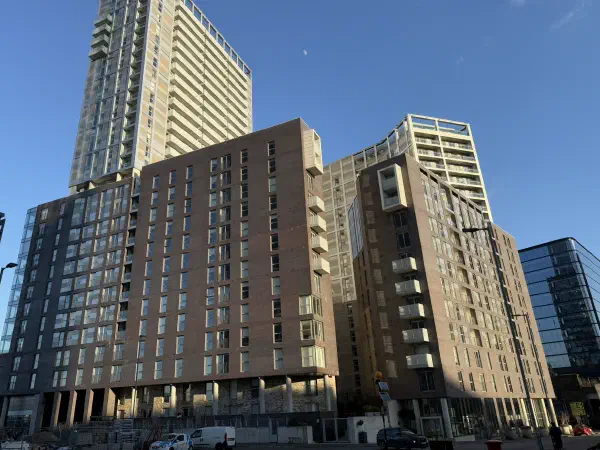
- Skyline framing: Use the arches or the balustrade line to frame the Greengate towers on the Salford side, or look the other way towards the spires and rooftops of the medieval quarter.
- Old-meets-new contrast: An 1820 Georgian crossing with 21st-century skyscrapers directly behind it is the signature Manchester–Salford juxtaposition, and nowhere serves it up more compactly.
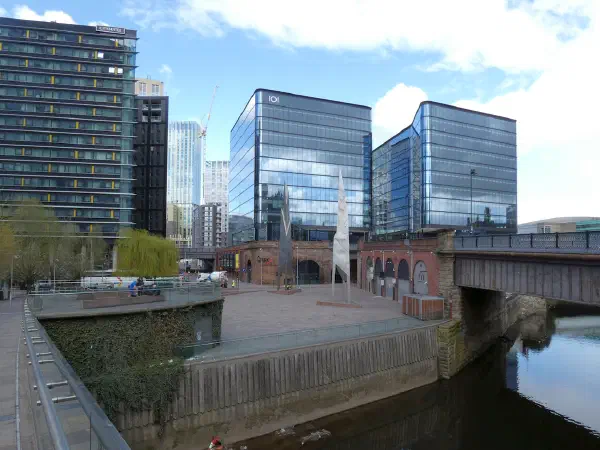
- River views: From the bridge deck you get clean sightlines up and down the Irwell, taking in the changing waterfront, Victoria Bridge and the cathedral beyond.
- Night photography: The surrounding towers and riverside lighting keep the scene alive after dark, and the bridge sits low enough that reflections in the Irwell do a lot of the compositional work for you.
Getting There
From Victoria tram stop it’s a five-minute walk: exit towards Victoria Street, pass Manchester Cathedral on your left, then continue along the river to Blackfriars Street — the bridge is directly ahead. Walking from St Peter’s Square or Deansgate, head down to St Mary’s Parsonage and you’ll hit Blackfriars Street in under ten minutes. The nearest parking is NCP Manchester Arndale (~£8–12/day), roughly a ten-minute walk via Corporation Street and the cathedral. Riverside steps on the Salford bank take you down towards water level for the low angles.
Photography FAQ
Is Blackfriars Bridge in Manchester the same as the one in London?
No — this is a completely different bridge. London’s Blackfriars Bridge crosses the Thames; Manchester’s is a smaller Georgian stone bridge over the River Irwell, linking Manchester city centre with Salford. They simply share a name.
When was Manchester’s Blackfriars Bridge built?
It opened on 1 August 1820, designed by Thomas Wright of Salford, replacing a 1761 wooden footbridge. It’s been Grade II listed since 1988, so the structure you photograph today is largely the original sandstone design.
Can you get down to river level at Blackfriars Bridge?
Yes — riverside walkways run along the Irwell here, particularly on the Salford bank near Greengate Square. That’s where you’ll find the low vantage points for arch-framing shots and reflections.
Is Blackfriars Bridge good for night photography?
Very. The Greengate towers behind it are lit after dark, the bridge sits over calm, reflective water, and the pavements are wide enough for a tripod. Blue hour is the sweet spot — see our Manchester blue hour guide for timings.
Do I need permission to use a tripod here?
No. The bridge and both riverbanks are public highway and public realm, so tripods are fine. Just keep clear of the carriageway and be considerate on the narrower sections of the riverside path.
Best Times to Shoot
- Blue hour is the prime window — the Greengate towers light up behind the stone arches, creating a vivid contrast of warm bridge stone and cool modern glass, all doubled in the river on a still evening.
- Golden hour from the Salford side sends low, directional light along the river and across the bridge’s stonework, revealing the texture of the 1820s masonry and picking out the Ionic pilasters on the central arch.
- After heavy rain the River Irwell rises and moves faster, giving you the chance to capture silky long-exposure water beneath the arches — and wet pavements double the lights at street level.
- Weekday early mornings offer empty pavements and calm water, ideal for tripod work without pedestrian or traffic disruption — something compact like the Peak Design Travel Tripod sets up quickly on the narrow walkway. The river is usually at its glassiest before the day’s boat and weir activity stirs it up.
- Misty autumn mornings flatter this stretch of the Irwell particularly well, softening the towers into the background and letting the Georgian bridge carry the frame.
Composition Ideas
- Arch framing: Get down to the riverside walkway and shoot through one of the three stone arches to frame the Greengate skyscrapers or Manchester Cathedral beyond — a 24–35 mm focal length keeps both arch and backdrop sharp.
- Leading lines: Use the bridge’s balustrade as a leading line running into the distance, with the modern skyline as the vanishing point. Shoot from the pavement edge at around 28 mm and keep the line in the lower third.
- Long-exposure river: Mount a tripod on the riverside walkway and use a 2–8 second exposure with an ND filter to smooth the Irwell’s surface while keeping the bridge pin-sharp against the lit towers.
- Reflection symmetry: On a calm morning, shoot from as close to water level as the walkway allows to capture the full bridge and its mirror image in the Irwell — centre the middle arch for a properly symmetrical frame.
- Two-cities telephoto: From Victoria Bridge upstream, a 70–135 mm compresses Blackfriars Bridge against the Salford towers behind it — the cleanest single image of the old crossing and the new skyline. The bridge also makes a natural stop on the medieval quarter to Spinningfields walk if you want to string several riverside spots together.
How to shoot it
Lens
A 16–35mm wide takes in reflections and foreground; switch to a 70–200mm to compress distant detail across the water.
Settings
Tripod, f/11, ISO 100 and a 1–8s exposure for glassy water and clean reflections; an ND filter extends it in daylight.
Composition
Shoot low to maximise the reflection, use the waterline as a leading line, and wait for still water to double the scene.
Timing
Blue hour — the ~20 minutes after sunset — is the sweet spot: the sky balances with the city's lights. Be set up before it starts; today's window is on this page.
More in Greengate
See the area →