Best at blue hour
Circle Square (Symphony Park)
Oxford Road Corridor · ManchesterSome gear links on this page are affiliate links — if you buy through them we may earn a small commission at no extra cost to you. See our affiliate disclosure.
What is Circle Square?
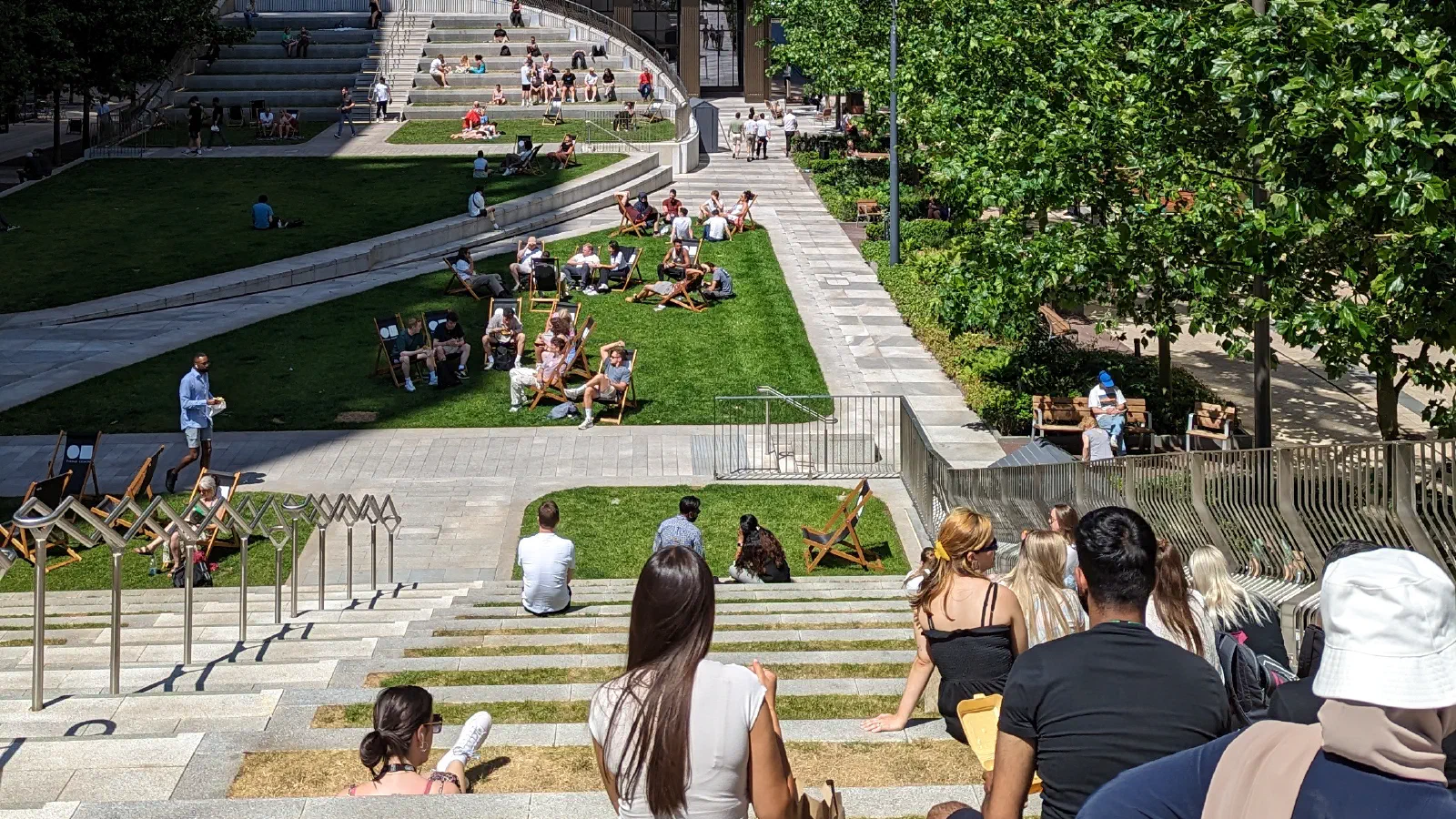
Circle Square is a major new development on the site of the former BBC Manchester headquarters on Oxford Road. At its heart lies Symphony Park, the first new city-centre park in Manchester in decades. The area is characterized by its distinctive “ribbon” architecture—terracotta-coloured buildings with sleek, geometric lines that frame the green space.
Why Shoot Here?
- Modern Architecture: The geometric facades and terracotta tiles offer excellent opportunities for architectural photography.
- Urban Green Space: Symphony Park provides a lush green contrast to the surrounding glass and steel.
- Night Photography: The area is beautifully lit at night, with reflections in the glass windows and glowing pathways.
- Geometric Lines: Use the “ribbon” design of the buildings for strong leading lines and framing.
Getting There
Manchester Oxford Road rail station is a three-minute walk, and Oxford Road’s bus corridor puts you at the door from almost anywhere south of the centre. St Peter’s Square Metrolink is about twelve minutes on foot. NCP First Street is the nearest car park at roughly £8–12 per day.
Symphony Park at the heart of the development is public and open 24/7, which makes this one of the few modern city-centre spots where a pre-dawn or late-night session is straightforward. The buildings around it are offices and residential, so the shoot is the park and the facades from it. Circle Square sits on the Oxford Road corridor, with the University of Manchester five minutes south and HOME about ten west.
Photography FAQ
Can you take photos at Circle Square?
Symphony Park is public and open around the clock, and photography including tripod work is unrestricted there. The surrounding buildings are private offices and apartments — shoot their facades from the park freely, but lobbies and interiors are not public space. As with any managed development, if you are set up with a tripod near an entrance someone may ask what you are doing; a straight answer settles it.
What is the best time to photograph Circle Square?
Blue hour, 20–40 minutes after sunset. The terracotta ribbon buildings have recessed lighting that comes on at dusk and the glass-fronted ground floors begin to glow, which is when the development’s futuristic character is most legible — Symphony Park’s lawn reads as a dark horizontal plane between two lit masses. Plan for 2–6 second exposures on a tripod. Golden hour works too on clear summer evenings, when low western sun enriches the burnt-orange cladding for about thirty minutes.
Why shoot it under cloud?
Because the terracotta colour is the point, and it reads truest in diffused light. Direct sun bleaches the cladding toward pale orange and makes the glass throw hard white reflections, so you lose both the colour and the ribbon-and-glass rhythm at the same time. Overcast midday holds the burnt-orange saturation and keeps the glazing readable. It is the least glamorous condition and the most reliable one.
What is the shot to get here?
Stand inside Symphony Park and shoot toward one of the curved terracotta facades at 24–35mm, using the horizontal layering as a frame above the lawn and the gap between ground level and the first ribbon tier to hold the sky behind. The alternative is the ground plane: the angular concrete paths converge at deliberate points, so stand where two meet and run both as diagonals into the frame at 16–24mm from a low angle.
What is Circle Square built on?
The site of the former BBC Manchester headquarters on Oxford Road. Symphony Park at its centre is the first new city-centre park Manchester had built in decades — a distinction it has since shared with Mayfield Park, which opened in 2022. The “ribbon” architecture, terracotta-coloured with sharp geometric lines framing the green space, is what gives the development a coherent visual identity rather than the assorted-glass-boxes look of other regeneration sites.
Best Times to Shoot
- Blue hour (20–40 minutes after sunset) — The terracotta ribbon buildings have recessed lighting that activates at dusk, and the glass-fronted ground floors begin to glow from interior office and lobby lights. This is when the futuristic quality of the development is most legible against a deep blue sky, and Symphony Park’s lawn reads as a dark horizontal plane between two lit masses — a compact tripod like the Manfrotto Befree Advanced Carbon handles the 2–6 second exposures this needs, and the park is public around the clock.
- Golden hour (late afternoon in summer) — The west-facing terracotta facades on the BBC former site catch warm, directional sun that enriches the burnt-orange cladding. The effect lasts about 30 minutes and is most dramatic on clear evenings in June and July when the sun is low but still above the Oxford Road corridor roofline.
- Weekday mornings (before 9 am) — Symphony Park’s lawns are empty of office workers and the pathways are unobstructed, letting you use the geometric design language of the ground plane — the angular paths, the planted zones — without figures breaking the composition.
- Overcast midday — The terracotta colour reads truest in diffused light; direct sun bleaches the facade and makes the glass surfaces reflect hard white. Clouds also prevent glare on the glass element of the buildings, letting you capture the ribbon-and-glass rhythm as intended.
Composition Ideas
- Ribbon building as frame — Stand inside Symphony Park and shoot toward one of the curved terracotta facades with a 24–35 mm lens. The building’s horizontal layering acts as a natural frame above the green lawn, and the gap between ground level and the first “ribbon” tier frames the cityscape or sky behind.
- Geometric pathway leading lines — The angular concrete paths through the park converge at deliberate focal points. Shoot from a corner where two paths meet and use both as diagonal leading lines disappearing toward the buildings — a 16–24 mm lens from a low angle exaggerates the geometry.
- Glass reflection at dusk — The glazed lower floors of the ribbon buildings begin to show interior lights at dusk. Shoot from across Symphony Park at 50 mm to capture the transition zone where reflection, transparency, and solid terracotta meet in the same facade panel.
- Wide establishing from Oxford Road — Step back to the Oxford Road pavement and shoot across the road to include both the Circle Square development and the tower of the BBC’s former headquarters visible behind. A 24 mm lens captures the full scope of the regeneration site against the Mancunian Way corridor.
How to shoot it
Lens
A 16–35mm wide exaggerates scale and verticals; a 24–70mm keeps proportions natural. A tilt-shift tames converging lines.
Settings
f/8–f/11 for front-to-back sharpness, ISO 100, and meter for the highlights so detail in the stonework holds.
Composition
Hunt for symmetry and repetition, keep verticals straight, and use doorways or arches to frame the subject.
Timing
Blue hour — the ~20 minutes after sunset — is the sweet spot: the sky balances with the city's lights. Be set up before it starts; today's window is on this page.
More in Oxford Road Corridor
See the area →