 Golden hour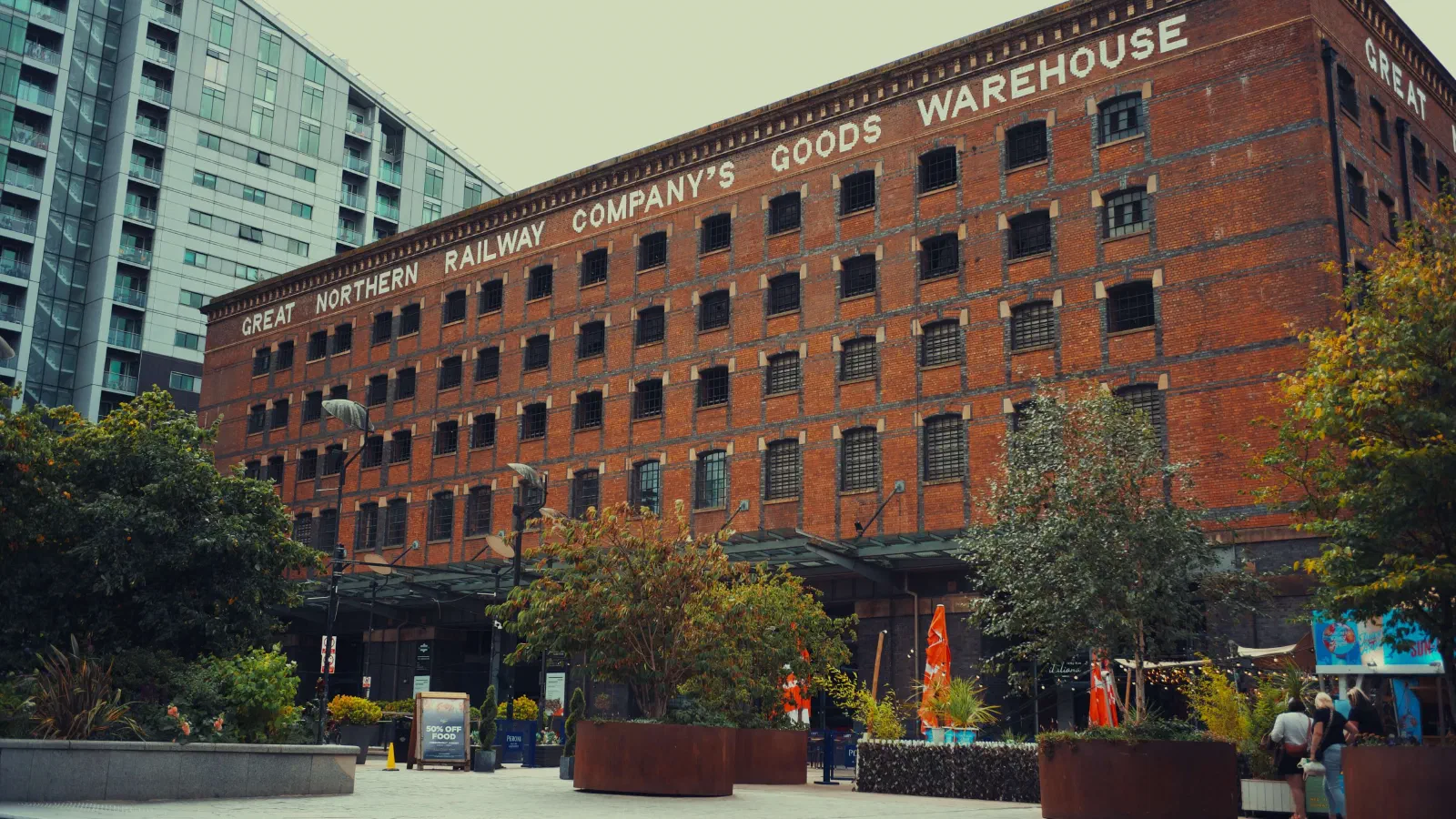
Best at blue hour
Great Northern Warehouse
Petersfield · ManchesterSome gear links on this page are affiliate links — if you buy through them we may earn a small commission at no extra cost to you. See our affiliate disclosure.
What is Great Northern Warehouse?
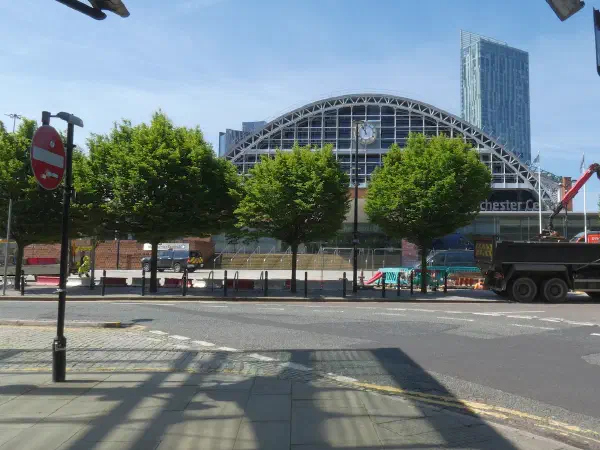
The Great Northern Warehouse is a Grade II* listed Victorian red-brick building located on Deansgate in Manchester city centre. Completed in 1899, it was originally constructed for the Great Northern Railway Company as a combined railway goods warehouse, canal basin, and storage facility (historicengland.org.uk).
Designed by William Leeming and G.T. Andrews, the warehouse was built on the site of the former Manchester and Salford Junction Canal basin. It was designed to handle massive volumes of freight arriving by train and barge, featuring hydraulic lifts capable of raising entire railway wagons to upper floors. With its imposing brickwork, arched windows, and monumental proportions, the building became a symbol of Manchester’s late 19th-century industrial might.
Following the decline of rail freight, the building fell into disuse in the mid-20th century before being redeveloped in the late 1990s. Today, the Great Northern Warehouse is a mixed-use leisure and entertainment complex, home to a cinema, restaurants, bars, and offices, while retaining its historic exterior and much of its industrial character (visitmanchester.com).
Why Shoot Here?
The Great Northern is one of the few places in the city centre where Victorian freight architecture survives at full scale, right on a main road, lit at night and approachable from every side:
- Industrial heritage at scale: The brickwork, arched loading bays and original iron features were built to move railway wagons, not to look decorative — the resulting proportions are far heavier and more repetitive than the city’s civic architecture, and they photograph as pattern rather than ornament.
- Leading lines and symmetry: The façade’s bay rhythm runs the length of Deansgate, giving you a ready-made repeating structure to work with. Shoot along it rather than straight at it and the arches compress into a strong diagonal.
- It works in bad light: Red brick and iron hold their character under the flat, grey skies Manchester delivers most of the year — this is a genuinely reliable overcast-day subject when the canal reflections and skyline views aren’t performing.
- Day and night are different buildings: Daytime emphasises texture, mortar and the weathering in the brick; after dark the façade lighting and signage pick out the arches and the mass of the building recedes into silhouette.
- Movement is built in: Deansgate traffic and the Metrolink line put controllable motion in the foreground of almost any frame, which is what lifts the building from a record shot to a photograph.
Getting There
The nearest tram stop is Deansgate-Castlefield, three minutes’ walk: come out onto Whitworth Street West and head north up Deansgate, and the warehouse’s bulk is unmistakable on your left. NCP Great Northern is on-site beneath the complex at roughly £8–12 per day, which makes this one of the easier city-centre spots to reach with a bag of gear. On foot it is about ten minutes down Deansgate from St Peter’s Square, and five minutes north of the Castlefield canals — the two pair naturally into a single blue-hour session.
Photography FAQ
Can you photograph inside the Great Northern Warehouse?
The interior is a working leisure complex — cinema, bars and restaurants — open to the public during venue hours, and casual handheld photography in the circulation areas is not usually an issue. It is private property rather than public highway, though, so tripods, lighting and anything that reads as a commercial shoot need permission from the venue or centre management first. The exterior, shot from the pavement, is the part you can work freely.
Is the Great Northern Warehouse free to visit?
Yes. The exterior is on a public street and visible at any hour, and there is no charge to enter the complex itself — you only pay for the cinema, bars and restaurants inside. For photographers, the best of the building is the outside, which costs nothing and is available around the clock.
What is the Great Northern Warehouse used for now?
It was built in 1899 as a combined railway goods warehouse, canal basin and storage facility for the Great Northern Railway Company, fell out of use as rail freight declined through the mid-20th century, and was redeveloped in the late 1990s. Today it holds a cinema, restaurants, bars and offices behind a retained historic exterior — which is why the façade still reads as a Victorian warehouse while the interior does not.
What lens do you need for the Great Northern Warehouse?
A 24–35 mm covers the full Deansgate frontage from across the road, which is the shot most people want. If you can only bring one lens, bring that. A short telephoto in the 50–85 mm range is the more interesting choice once you have the establishing frame, because it lets you isolate single arches and compress the bay rhythm into repeating geometry.
When is the best time to photograph the Great Northern Warehouse?
Blue hour, comfortably. The façade lighting and signage come up while the sky still holds colour, and the Deansgate traffic gives you light trails — roughly a 20–40 minute window after sunset depending on season. Morning between 8 and 10 is the alternative if you want warm light on the brick and a quieter pavement.
Further Information
- Historic England – Great Northern Warehouse — official listing details and architectural description
- Visit Manchester – Great Northern Warehouse — current tenants, facilities, and events
- Manchester History – Great Northern Railway Goods Warehouse — historical background and images
- Cinema and Dining at Great Northern — venue guide for leisure activities inside the building
Best Times to Shoot
- Morning (8–10am): East-facing light warms the red brickwork on the Deansgate facade, bringing out rich tones and deep texture in the masonry before crowds arrive.
- Blue hour (dusk): The building’s illuminated arches and signage glow against a deep blue sky, creating a dramatic contrast perfect for long exposures — something compact like the Peak Design Travel Tripod earns its place in the bag for this shot.
- Night: Vehicle light trails along Deansgate and the surrounding streets add energy and movement to compositions featuring the warehouse facade.
- Overcast days: Flat, even light is ideal for capturing the intricate brickwork detail and ironwork without harsh shadows obscuring the architectural features.
Composition Ideas
- Shoot the full Deansgate frontage from across the road: Use a 24–35mm lens to capture the full scale of the building with converging lines from the pavement leading toward it.
- Isolate the arched loading bays: A 50–85mm lens lets you frame individual arches and their ironwork details, emphasising the repetitive geometry of the Victorian design.
- Include tram lines and traffic for urban context: Position yourself where passing Metrolink trams or vehicles create foreground motion blur against the static warehouse behind.
- Detail shots of plaques and ironwork: Get close to original railway company signage, iron brackets and decorative elements for heritage-focused close-ups.
Shooting the Warehouse at Blue Hour
The Great Northern is at its best as the light fades. The facade lighting and signage warm up while the sky still holds a deep blue, and the Deansgate traffic adds movement:
- Arrive ~30 minutes before sunset to set up and catch the transition — blue hour itself lasts only 20–40 minutes depending on season.
- Use a tripod and a 1–4 second exposure to render passing trams and traffic as light trails against the static brickwork. Deansgate carries heavy traffic, so ground vibration is real here — the blue hour tripod guide explains how to set up against it.
- For the full timing and technique, see our Manchester blue hour photography guide and the night photography guide.
Nearby Spots & Related Guides
Sitting just off Deansgate by Deansgate-Castlefield tram, the warehouse is moments from the city’s best canal scenery:
- Castlefield Canals and the Castlefield Viaduct sky park — five minutes south, ideal to pair at blue hour.
- Deansgate Locks — illuminated bars over the water, another strong dusk subject.
- John Rylands Library — the grand neo-Gothic interior a short walk up Deansgate.
- Plan a route on the map or browse all city-centre spots.
For kit, see the Manchester architecture gear guide; for elevated city views, the skyline viewpoints guide.
How to shoot it
Lens
A 16–35mm wide exaggerates scale and verticals; a 24–70mm keeps proportions natural. A tilt-shift tames converging lines.
Settings
f/8–f/11 for front-to-back sharpness, ISO 100, and meter for the highlights so detail in the stonework holds.
Composition
Hunt for symmetry and repetition, keep verticals straight, and use doorways or arches to frame the subject.
Timing
Blue hour — the ~20 minutes after sunset — is the sweet spot: the sky balances with the city's lights. Be set up before it starts; today's window is on this page.
More in Petersfield
See the area →