 Blue hour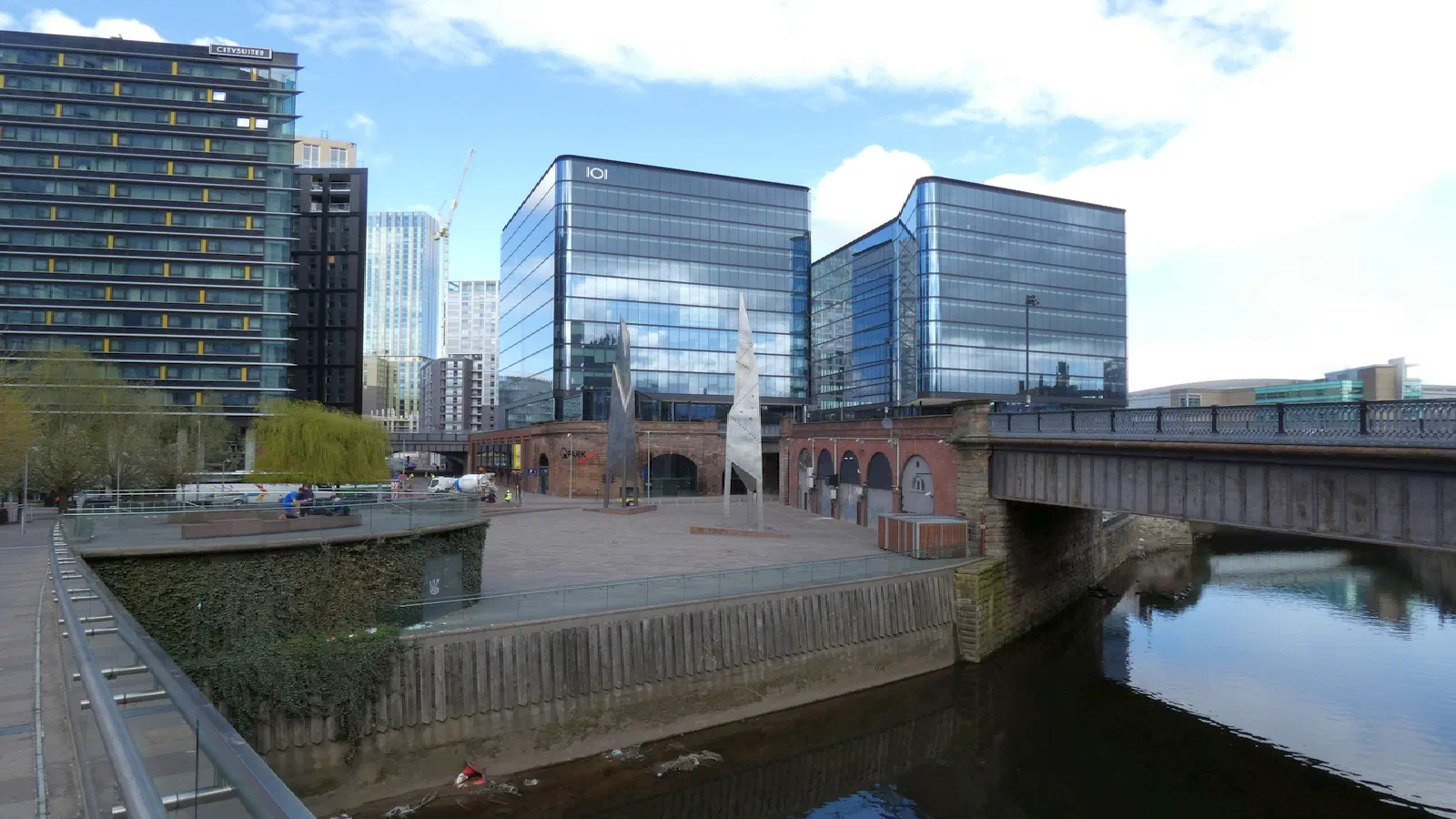
Best at night
Greengate Square
Greengate · ManchesterSome gear links on this page are affiliate links — if you buy through them we may earn a small commission at no extra cost to you. See our affiliate disclosure.
What is Greengate Square?
Greengate Square is a modern public space on the Salford bank of the River Irwell, directly across the water from Manchester Cathedral. It opened in 2013 as a £13m public realm scheme on the site of the former Victoria bus station, and it marks the historic heart of Salford — Greengate was the oldest part of the medieval town, the administrative centre for a hundred that covered most of what is now Greater Manchester. Today almost nothing medieval survives above ground, but the square restores a sense of arrival to the spot where Salford began.
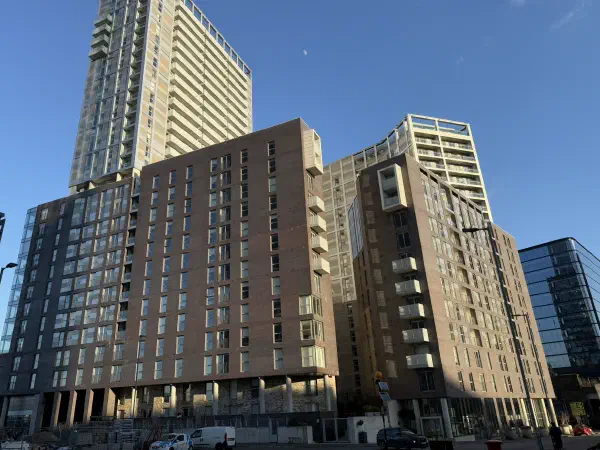
For photographers, the square packs a lot into a small footprint: a stepped amphitheatre of seating facing the river, 36 programmable coloured fountains that fire from the paving, atmospheric LED lighting after dark, and a backdrop of the Greengate cluster’s glass residential towers. Look south-east across Victoria Bridge and the cathedral’s sandstone tower sits framed between modern buildings — the old city and the new quarter in a single glance. It’s one of the few places where you can photograph Manchester from Salford and Salford from Manchester within a two-minute walk.
Why Shoot Here?
- Juxtaposition: Capture the contrast between the historic Manchester Cathedral across the river and the ultra-modern glass towers rising directly behind the square.
- Light fountains: The 36 jets are illuminated in changing colours after dark — a ready-made foreground for long exposures, and in cold weather the lit spray reads almost like smoke.
- The amphitheatre: The stepped seating creates strong, repeatable leading lines and elevated vantage points over the fountain plaza and the river.
- Urban life: Children run the fountains in summer, commuters cut through between the two cities, and events fill the amphitheatre — good raw material for street photography.
- Riverside connections: The square links straight onto the Irwell riverside walk, with Blackfriars Bridge two minutes downstream — easy to combine into one session.
Getting There
From Victoria tram stop it’s a five-minute walk: exit towards Victoria Street, pass Manchester Cathedral, cross the Irwell on Victoria Bridge Street and the square opens up on your right between the bridge and the river. From Exchange Square or the Arndale it’s under ten minutes on foot. Drivers should use NCP Greengate (~£6–10/day), barely two minutes from the square itself. The riverside path connects the square to Blackfriars Bridge and the wider Greengate development, so you can shoot the whole stretch without recrossing a road.
Photography FAQ
When do the Greengate Square fountains come on?
The fountains run during the day and are illuminated in colour after dark, though they’re programmable and occasionally switched off for events or maintenance in winter. For photography, arrive at dusk — you get the lit jets while there’s still colour in the sky.
Is Greengate Square in Manchester or Salford?
Salford — the River Irwell is the boundary, and the square sits on the Salford bank opposite Manchester Cathedral. Greengate was the heart of medieval Salford, which is exactly why the cathedral view across the river works so well as an old-meets-new composition.
Can I use a tripod in Greengate Square?
Yes — it’s open public realm and tripods are generally no problem, especially in the evening when the square is quiet. As with any managed public space, be prepared to move along if an event is being set up in the amphitheatre. This is an exposed spot beside the river, so wind is the practical enemy rather than permission: keep the centre column down and hang your bag from the hook. Our blue hour tripod guide covers the setup in detail.
What’s the best night photography composition here?
The illuminated fountains in the foreground with the lit Greengate towers behind, shot at 1–4 seconds on a tripod. It features in our guide to Manchester night photography locations for good reason — the combination of water, colour and glass is hard to beat in such a small area.
What else can I photograph nearby?
Blackfriars Bridge is two minutes along the river, the cathedral and Chetham’s Library are five minutes across Victoria Bridge, and the rest of the Greengate towers surround you. You can fill a whole blue-hour session without walking more than ten minutes.
Best Times to Shoot
- Blue hour (just after sunset): The glass towers of Greengate light up while the sky retains deep blue tones, and the illuminated fountains come alive — the ideal overlap of ambient and artificial light, and the single best window here.
- Golden hour (late afternoon): Warm low sun bounces off the glass facades, creating vivid reflections and colour gradients across the square and onto the river; the cathedral’s sandstone glows in the same light.
- Night: The fountains are at their most dramatic after dark; use a tripod and exposures of 1–4 seconds to capture the water trails and illuminated tower backdrops — a steady set of legs like the Peak Design Travel Tripod is essential here. Cold, still nights add visible vapour above the jets.
- Summer daytime: The fountains become a playground — bring a fast shutter (1/1000s or quicker) to freeze water and movement for candid street work.
- Weekend mornings: Fewer commuters crossing the square means cleaner architectural compositions, and the low eastern light rakes across the amphitheatre steps.
Composition Ideas
- Frame the cathedral from the steps: Climb the amphitheatre seating and shoot south-east across the Irwell so Manchester Cathedral sits between the bridge and the modern buildings — the definitive old-meets-new frame from this spot.
- Use the stepped seating as leading lines: Shoot along the tiered steps at a low angle with a 16–24 mm lens to draw the eye toward the towers or the river beyond.
- Long exposures of the light fountains: Tripod low, 1–2 second exposure, fountains as glowing streaks against the tower lights — try several colour cycles, as the programmed sequences change the mood of the frame completely.
- Wide-angle reflections on wet paving: After rain, the polished stone mirrors the towers and sky — shoot from ground level for dramatic symmetry, with the fountain jets breaking the reflection.
- Through-the-spray telephoto: From the far side of the square, use a 70–135 mm such as the 70–200mm telephoto to compress people walking through the backlit fountain spray against the dark glass behind — best in late, low sun.
How to shoot it
Lens
A 16–35mm wide exaggerates scale and verticals; a 24–70mm keeps proportions natural. A tilt-shift tames converging lines.
Settings
f/8–f/11 for front-to-back sharpness, ISO 100, and meter for the highlights so detail in the stonework holds.
Composition
Hunt for symmetry and repetition, keep verticals straight, and use doorways or arches to frame the subject.
Timing
This one comes alive after dark, once signage and lighting take over. Wait for the sky to go fully dark for the cleanest, richest colour.
More in Greengate
See the area →Nearby spots
Blue hour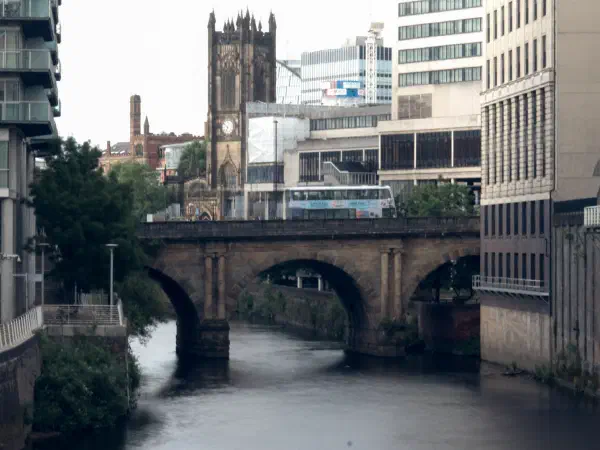 Blue hour