 Golden hour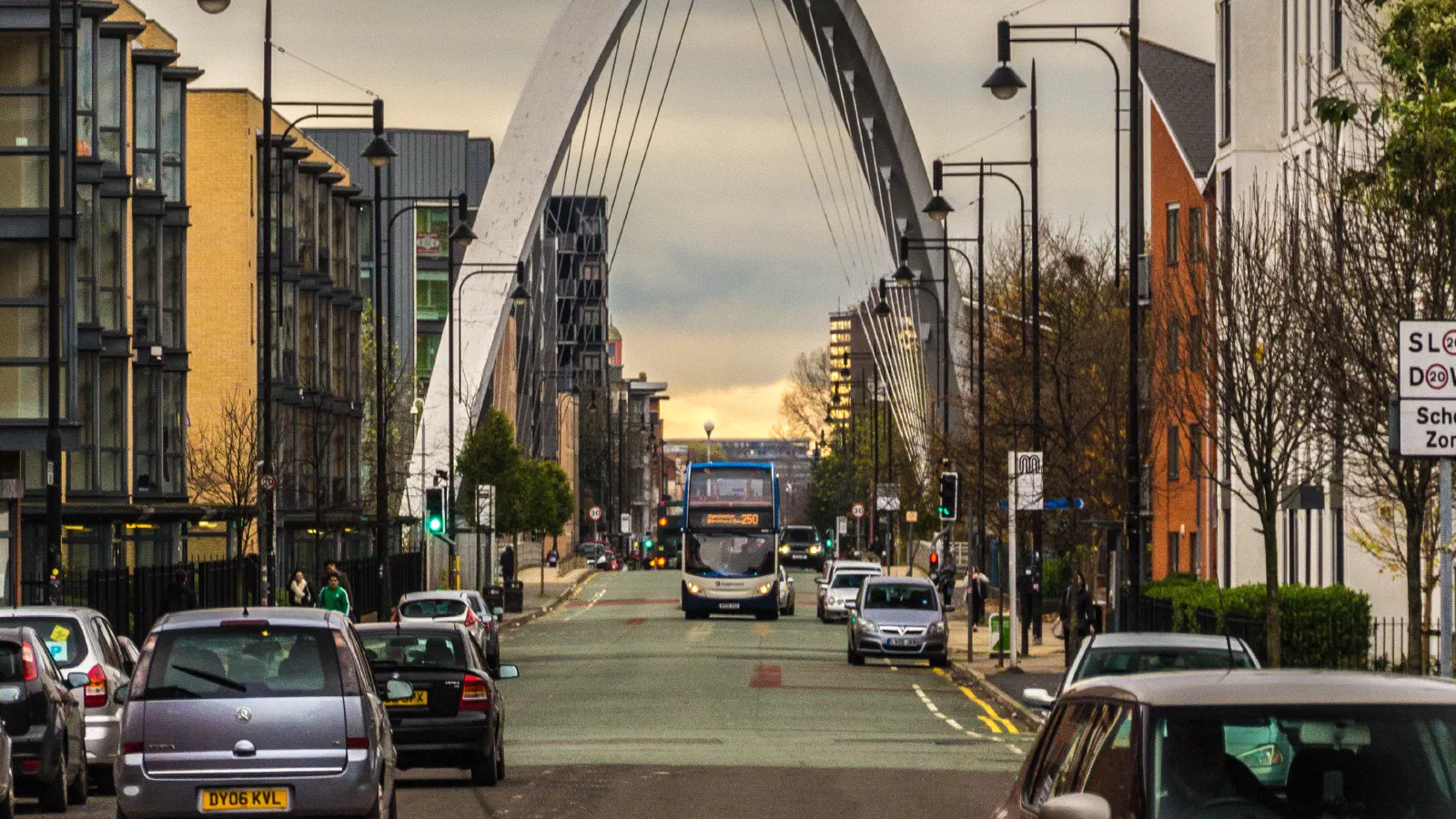
Best at night
Hulme Arch Bridge
Hulme · Manchester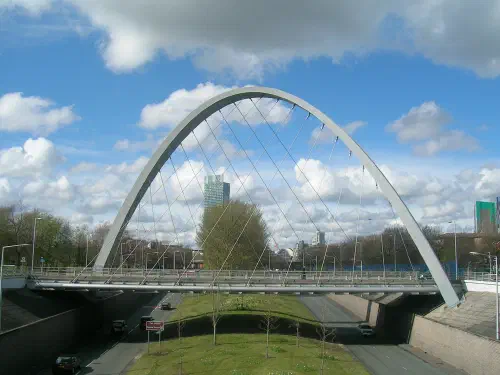
Some gear links on this page are affiliate links — if you buy through them we may earn a small commission at no extra cost to you. See our affiliate disclosure.
What is Hulme Arch Bridge?
The Hulme Arch Bridge is a striking modern road bridge in south Manchester, carrying Stretford Road over Princess Road and linking the city centre with the Hulme district. Officially opened in 1997, it was the centrepiece of a major regeneration scheme for Hulme after decades of demolition and rebuilding (en.wikipedia.org).
Designed by Chris Wilkinson Architects (now WilkinsonEyre), the bridge is instantly recognisable for its single sweeping white steel arch, set diagonally across the deck and supporting it with a fan of cable stays. The diagonal arrangement is the clever part photographically: the arch reads completely differently depending on where you stand, twisting from a clean parabola to a dramatic crossing X of cables as you move around it.
The design is also symbolic — it deliberately re-stitched Hulme to the rest of the city after the construction of Princess Road severed the two in the 1960s. Part infrastructure, part public sculpture, it has become a genuine local landmark, and because it sits over one of Manchester’s busiest arterial roads, it doubles as one of the city’s most dependable light-trail locations — see our Manchester night photography guide for more after-dark spots.
Why Shoot Here?
Hulme Arch Bridge is a superb subject for architectural and night photographers, and it’s far less photographed than the city-centre landmarks:
- Bold geometry: A single white arch, taut cables and a straight deck — the structure is essentially a ready-made graphic composition.
- Night-time impact: The bridge is illuminated after dark, and the constant traffic on Princess Road below feeds long exposures with red and white light trails.
- It changes as you move: Because the arch crosses the deck diagonally, every 20 metres of repositioning gives you a different structure — symmetric from beneath, dynamic and skewed from the corners.
- Urban context: From the right angles you can stack the arch against the city skyline, with the Beetham Tower and the Deansgate cluster rising behind it — a genuinely underused skyline composition.
- Quiet and practical: Unlike city-centre spots, you can set up a tripod here without crowds, and there’s free street parking on Stretford Road within sight of the bridge. Hulme Park is moments away if you want to extend the session.
- Works in poor weather: Wet tarmac amplifies the lights, and the white steel stays punchy under flat grey skies.
Getting There
The nearest tram stop is Cornbrook, about a 5-minute walk away — head east towards Princess Road and the white arch is visible well before you reach it. On foot from the city centre, start at the Beetham Tower at the southern end of Deansgate, follow Chester Road and turn onto Stretford Road, which leads straight to the bridge in roughly 15 minutes. Drivers have it easy: there’s free street parking on Stretford Road close to the arch, so you can carry a tripod and filters without a long walk.
Photography FAQ
When was the Hulme Arch Bridge built?
It officially opened in 1997, built as part of the regeneration of Hulme. The design intentionally reconnected the district with the city centre after Princess Road cut through the area in the 1960s.
Who designed the Hulme Arch Bridge?
It was designed by Chris Wilkinson Architects, the practice now known as WilkinsonEyre. The signature move is the single steel arch set diagonally across the deck, carrying the bridge on splayed cable stays.
Can you walk across the Hulme Arch Bridge?
Yes — Stretford Road runs over the bridge with public footpaths on both sides, open at all hours at no cost. The pavements are wide enough for a tripod, but keep clear of the kerb and stay aware of traffic, especially at night.
What are the best settings for light trails at Hulme Arch Bridge?
Tripod, base ISO, f/8–f/11 and exposures of 10–30 seconds, timed as traffic flows beneath on Princess Road. A sturdy travel tripod like the Peak Design Travel Tripod is essential for trails this clean. At blue hour shorter exposures work because traffic is heavy; later at night you’ll want the longer end to gather enough trails. See our blue hour guide for timing the sky and the architecture gear guide for tripod and filter choices.
Can you fly a drone at Hulme Arch Bridge?
Assume not without serious homework. The bridge spans a busy arterial road close to central Manchester, and CAA rules prohibit flight over uninvolved people and moving traffic for most drones — city-fringe flying is heavily restricted in practice. Check the CAA Drone Code and an airspace app before considering it.
Further Information
- Wikipedia – Hulme Arch Bridge — history, design, and construction details
- Structurae – Hulme Arch Bridge — engineering and technical specifications
Best Times to Shoot
- Blue hour (20–40 minutes after sunset): The illuminated bridge sits against a deep blue sky while headlights on Princess Road draw vivid trails beneath it — this is the signature shot, and the window is short, so arrive set up.
- Golden hour: Warm, low-angled light models the white steel arch and cables and throws long shadows across the deck. The white paintwork takes on the colour of the light, so the arch can glow amber against a cooler sky.
- Late night (after 10pm): Traffic thins enough for clean 15–30 second exposures with distinct, uncluttered trails rather than a solid wall of light.
- After rain: Wet tarmac reflects the bridge lighting and vehicle trails, effectively doubling the light in the frame — combined with blue hour, the highest-impact condition here.
Composition Ideas
- Low central angle for symmetry: Stand on the pavement directly beneath the arch and shoot upward with a wide-angle lens (14–20mm) to emphasise the sweeping curve and radiating cable stays.
- Long-exposure light trails from the roadside: Set up on the footpath facing along Princess Road and use 10–30 second exposures to thread red and white vehicle trails under the arch.
- Telephoto compression from a distance: A 70–200mm such as the 70–200mm f/4 from along Stretford Road compresses the arch against the Manchester skyline behind it, stacking layers of structure into one flattened frame.
- Arch against the sky: Isolate the white curve and cables against clear blue or dramatic cloud for a minimalist architectural study — this is where the diagonal geometry pays off, so circle the bridge and watch the cables realign.
- Work the diagonals: From the corners of the junction the cables cross visually in an X over the deck; shoot from there for a more aggressive, abstract take than the standard symmetric view.
How to shoot it
Lens
A 16–35mm wide exaggerates scale and verticals; a 24–70mm keeps proportions natural. A tilt-shift tames converging lines.
Settings
f/8–f/11 for front-to-back sharpness, ISO 100, and meter for the highlights so detail in the stonework holds.
Composition
Hunt for symmetry and repetition, keep verticals straight, and use doorways or arches to frame the subject.
Timing
This one comes alive after dark, once signage and lighting take over. Wait for the sky to go fully dark for the cleanest, richest colour.
More in Hulme
See the area →Nearby spots
Golden hour Blue hour