 Blue hour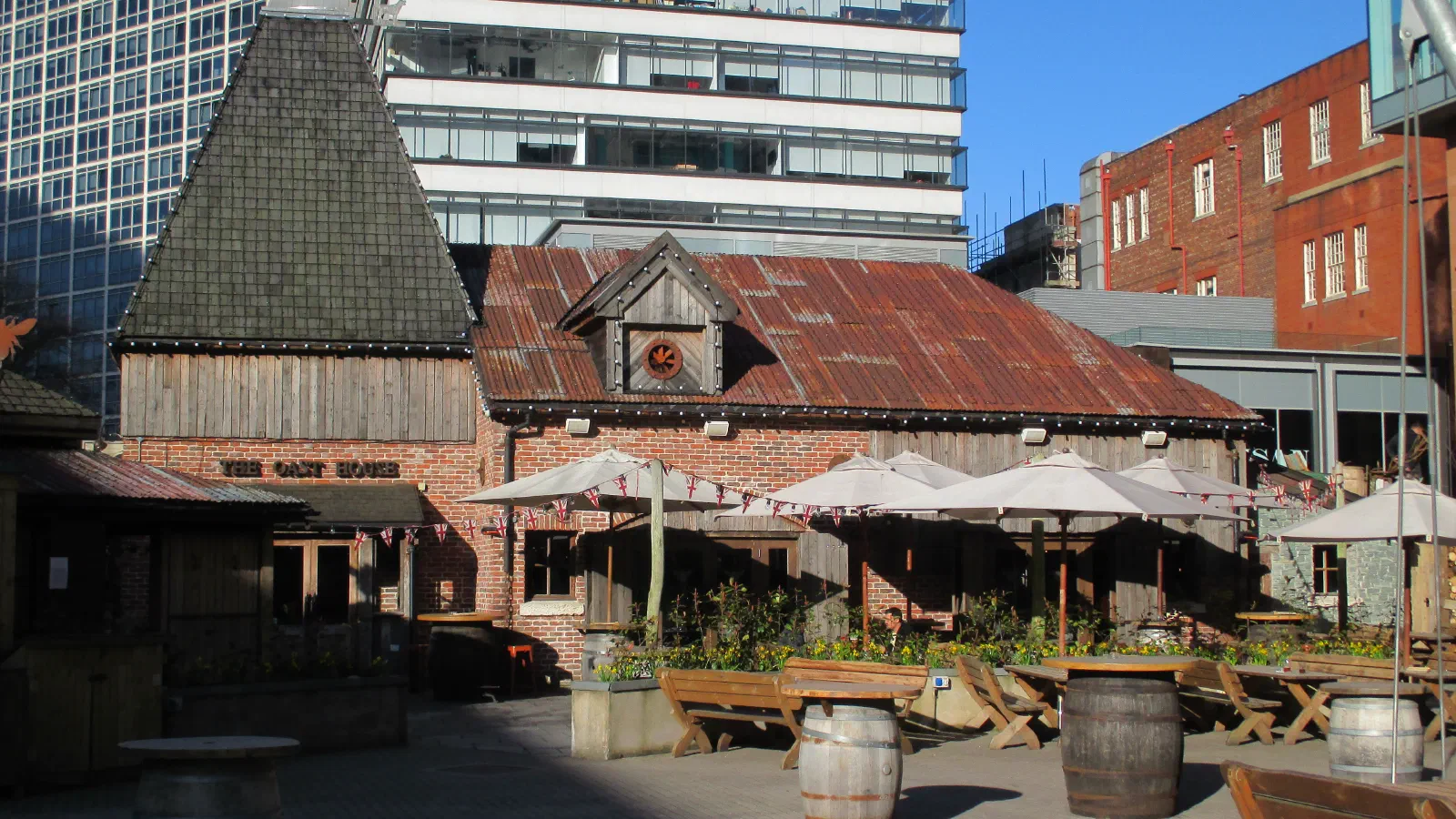
Best at night
The Oast House & Courtyard
Spinningfields · ManchesterSome gear links on this page are affiliate links — if you buy through them we may earn a small commission at no extra cost to you. See our affiliate disclosure.
What is The Oast House?
The Oast House is a curious piece of rustic architecture in the heart of the ultra-modern Spinningfields district. Originally a hop-drying kiln (or Oast House) in Kent, it was dismantled and rebuilt here, now serving as a popular bar and restaurant with a large outdoor courtyard.
Why Shoot Here?
- Rustic vs. Modern: The rustic, timber-framed Oast House provides a brilliant visual contrast to the surrounding glass and steel skyscrapers.
- Vibrant Atmosphere: The courtyard is a hive of activity, especially in the summer or during Christmas markets, making it perfect for capturing local social life.
- Festoon Lighting: The courtyard is often draped in fairy lights and festoon lighting, creating a magical atmosphere for evening and night photography.
- Events and Live Music: The outdoor stage often hosts live music, providing opportunities for capturing performance and crowd energy.
Getting There
Deansgate-Castlefield Metrolink is a five-minute walk and St Peter’s Square about the same. NCP Spinningfields is the nearest car park at roughly £8–12 per day. The Oast House sits in the middle of the Spinningfields courtyard, surrounded by glass towers — you will see the conical roof before you find the entrance.
The courtyard and outdoor bar area are publicly accessible, but this is a working bar and restaurant and the courtyard is its trading space, so plan on being a customer if you are going to spend time there. Like the rest of Spinningfields, it is a managed estate and security may ask what you are doing if you set up a tripod. The Avenue is a minute away and the medieval quarter to Spinningfields walk finishes in the district.
Photography FAQ
Can you take photos at The Oast House?
The courtyard is publicly accessible and handheld photography there is unremarkable — it is one of the most photographed spots in Spinningfields. Be a customer if you are staying a while, keep other drinkers out of your frames, and ask before photographing anyone at a table. A tripod in a busy courtyard bar is a different matter: possible on a quiet weekday, awkward at any other time, and worth clearing with staff rather than assuming.
What is the best time to shoot The Oast House?
Dusk, roughly 17:30–19:00 depending on season. The festoon lights come on while there is still about twenty minutes of ambient sky light, and that mixed window — warm string lights against a blue-purple sky — is when the conical roof and dark timber read against a sky that has not yet gone black. Miss it and you have warm lights on a flat black background, which is a much weaker image.
Why does it look like that?
Because it is a genuine oast house — a hop-drying kiln, originally from Kent, dismantled and rebuilt here. That is the entire photographic point of the location: a piece of rural agricultural architecture standing in the middle of a glass-and-steel commercial district. Every composition worth making here uses that contrast rather than treating the building as a standalone subject.
What is the shot to get?
Stand in the centre of the courtyard and aim a 16–24mm upward at the conical roof, with the festoon lights radiating outward from the peak and one or two Spinningfields glass towers kept in frame behind the roofline. That single frame contains the whole idea. The variant is to get to knee height with a 14–20mm at the entrance, so the timber looms in the foreground and a tower soars behind it — the exaggerated perspective makes the contrast harder still.
When is the courtyard at its best for atmosphere?
Weekend afternoons in summer, 14:00–18:00 from May to September, for outdoor drinking, live music and the full social energy of the place. Or the Christmas market season from November, when the surrounding area fills with stalls, garlands and extra lighting — the timber-and-fairy-light aesthetic suits winter decoration, and the contrast with the glass towers is at its most pronounced. For clean architectural work instead, come on an overcast day, when cloud tones the sky down and opens up the dark weathered timber at the same time.
Best Times to Shoot
- Early evening (dusk, around 17:30–19:00) — The festoon lights switch on as natural light fades, but for approximately 20 minutes there is still enough ambient sky light to balance the warm string lights without the sky going completely black. This mixed-light window — warm festoon against a blue-purple dusk sky — is specific to this window and produces the Oast House’s most flattering look, with the conical roof and dark timber visible against a still-readable sky.
- Christmas market season (November–January) — The area around the Oast House and Spinningfields fills with seasonal market stalls, garlands, and additional lighting during winter. The Oast House courtyard takes on a particularly festive character — the timber and fairy-light aesthetic works extremely well with winter decorations and the contrast with the surrounding glass towers is most pronounced.
- Weekend afternoons in summer — The courtyard and outdoor space are busiest between 14:00 and 18:00 on Saturdays from May to September, with outdoor drinkers, occasional live music, and the full social energy of the venue. This is the candid lifestyle window for capturing Manchester’s outdoor-bar culture in an unusual setting.
- Overcast days — The contrast between the dark weathered timber of the Oast House and a bright sky is considerable; direct sun creates underexposed timber or overexposed sky. Cloud cover tones down the sky and opens up the timber surfaces simultaneously, making it much easier to expose the building cleanly.
Composition Ideas
- Upward from the courtyard with festoon lights and Spinningfields towers — Stand in the centre of the courtyard and aim a 16–24 mm wide-angle upward toward the conical Oast House roof. Include the festoon lights radiating outward from the roof peak, and keep the framing wide enough to include one or two of the Spinningfields glass towers behind the roofline. This is the shot that captures the core contrast of the site.
- Low wide-angle rustic versus glass — Get low (knee height) and use a 14–20 mm lens pointed at the Oast House entrance, with a long-distance Spinningfields tower rising behind. The exaggerated wide-angle perspective makes the timber building loom in the foreground and the glass tower soar in the background, emphasising the contrast between agricultural building and 21st-century commercial district.
- Live music candid at f/2.8 — When performers are on the outdoor stage or in the courtyard, use a fast 85 mm at f/1.8–f/2.8 from across the courtyard. Focus on the performer and let the crowd in the foreground blur to soft shapes. The festoon lights and timber facade provide a warm, distinctive backdrop that locates the image specifically at the Oast House.
- Symmetrical entrance framing — Position yourself 3–5 metres from the main Oast House entrance and shoot dead-on at 35–50 mm. The conical roof above, the timber doorway, and any seasonal decoration frame the shot symmetrically. This entrance-portrait approach works well as a standalone graphic image and is less dependent on time of day than wider environmental compositions.
How to shoot it
Lens
A 35mm or 50mm prime is ideal — small, fast and unobtrusive for candid frames and shopfront detail.
Settings
Shutter priority at 1/250s or faster to freeze movement, with Auto ISO so you can keep shooting as the light shifts.
Composition
Work the light and shadow, look for layers and gesture, and let strong shopfront colour or signage carry the frame.
Timing
This one comes alive after dark, once signage and lighting take over. Wait for the sky to go fully dark for the cleanest, richest colour.
More in Spinningfields
See the area →