 Any / overcast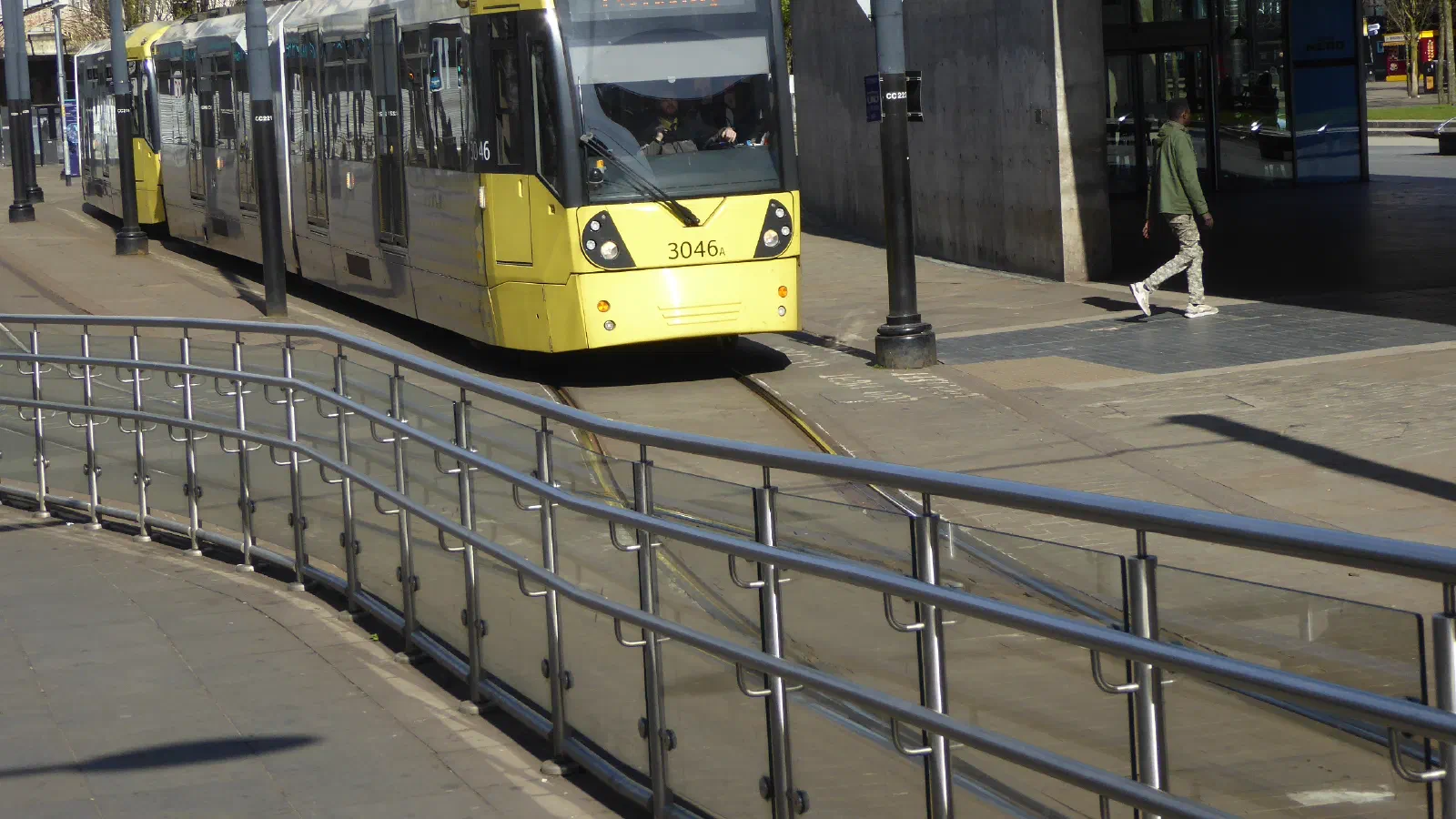
Best at golden hour
Piccadilly Gardens
City Centre · ManchesterSome gear links on this page are affiliate links — if you buy through them we may earn a small commission at no extra cost to you. See our affiliate disclosure.
What is Piccadilly Gardens?
Piccadilly Gardens is a central public square in Manchester city centre, bounded by Mosley Street, Parker Street, Portland Street, and Piccadilly (Wikipedia – Piccadilly Gardens). Originally a patch of clay pits known as the “Daub Holes,” the area was transformed into a landscaped ornamental garden and formal esplanade in the 18th and 19th centuries. Over time, the Manchester Royal Infirmary and a mental asylum once stood here before their removal post-1908 paved the way for the park’s creation.
The present layout was developed between 2001 and 2003 by a consortium including EDAW, Arup Group, and architect Tadao Ando. It features a flat lawn, computer-controlled water fountain plaza, geometric paths, a modern pavilion, and selected tree plantings. Today, Piccadilly Gardens also serves as a major transport hub—integrating a Metrolink tram stop (opened in 1992, updated in 2009) and bus interchange—with pedestrian space, seating, and a popular street-food market operating midweek (Wikipedia – Piccadilly Gardens tram stop).
Why Shoot Here?
Piccadilly Gardens divides opinion as a public space, but as a photographic subject it is one of the most productive places in the city — because it is about people, not architecture:
- Constant human traffic: Trams arriving, commuters crossing, buses loading, street-food queues forming. This is the highest-density pedestrian crossroads in central Manchester, which makes it the closest thing the city has to a guaranteed street-photography location. You can work one position and let frames come to you.
- Architectural contrast to shoot against: The fountain plaza and the concrete pavilion give you hard minimalist geometry to set moving people against, with mid-century and modern blocks like One Piccadilly Gardens closing the backdrop.
- A controllable moving element: The fountains can be frozen at 1/1000 s or smoothed to a veil at 1–2 seconds, which means one subject gives you two completely different images without moving your feet.
- It is transformed by rain: The large flat paving turns mirror-like in the wet, doubling tram lights, signage and umbrellas. Bad weather improves this location, which is true of very few spots in the guide.
- Seasonal reinvention: In winter the square becomes a Christmas market and events site — covered marquees, lights and performances — swapping the open-plaza look for something dense, warm and documentary.
- Historic layering: Clay pits known as the “Daub Holes”, then infirmary grounds, then formal Victorian gardens, then the 2001–03 redesign by EDAW, Arup and Tadao Ando. Little of that is visible in a single frame, but it is useful context for a caption or a series.
Getting There
Easier than any other spot in the guide: the Piccadilly Gardens Metrolink stop is in the square itself, served by most lines across the network, and the bus interchange sits on the same footprint. NCP Piccadilly Place is the nearest car park at roughly £8–12 per day, five minutes’ walk — though with a tram stop on the square there is little reason to drive. Manchester Piccadilly rail station is a ten-minute walk down Piccadilly approach. The Northern Quarter begins a few minutes north, which makes this the natural first or last stop on a city-centre street-photography route.
Photography FAQ
Can you take photos in Piccadilly Gardens?
Yes. It is a public park and open at all hours, and photography — including street and candid work — is permitted. Normal courtesies apply: it is a busy transport interchange used by people going about their day, so be discreet, don’t obstruct tram or bus access, and stop if someone objects. Organised commercial or fashion shoots with crew and lighting are a different matter and need to be cleared with the council.
Is Piccadilly Gardens worth photographing?
As a piece of landscape design it has been widely criticised, and if you arrive expecting a beautiful park you will be disappointed. As a place to photograph people, it is one of the best locations in Manchester — the density and variety of foot traffic is unmatched, and the hard modern backdrop suits candid work. Come for the street photography, not the gardens.
When is Piccadilly Gardens busiest?
Weekday lunchtimes, roughly 12:00–14:00, are peak — office workers, tram passengers and food-stall queues all at once. That is the best time if crowds are your subject and the worst if you want clean architectural sightlines. For the latter, come on a weekend morning.
What is the best light at Piccadilly Gardens?
Golden hour warms the open plaza and the surrounding blocks, and low sun across the square throws long shadows that work well from above eye level. Blue hour is the stronger option if you want the fountains and pavilion lighting to register against the sky. Rainy evenings are the specialist’s choice, when the paving reflects everything back.
Is Piccadilly Gardens safe for photographers?
It is a busy, well-used public square in the middle of the city and is fine to shoot in during daylight and normal evening hours. It has a reputation for antisocial behaviour after dark, so the usual city-centre sense applies late at night: keep your bag closed, keep expensive kit on the strap rather than on the ground, and be aware of who is around you when you are looking through the viewfinder.
Further Information
- Wikipedia – Piccadilly Gardens — detailed history, layout, and architectural redesigns
- Manchester City Council – Piccadilly Gardens — facilities, events, and public space management
- Wikipedia – Piccadilly Gardens tram stop — transport context and infrastructure details
- Wikipedia – One Piccadilly Gardens — building design, heritage, and place within the square’s redevelopment
Best Times to Shoot
- Lunchtime on weekdays brings peak foot traffic — trams gliding past, office workers crossing the square, and street food vendors serving queues, all ideal for dynamic urban storytelling.
- Blue hour illuminates the fountain plaza and Tadao Ando pavilion with artificial lighting while the sky retains a deep gradient, creating balanced exposures for long-exposure shots.
- Rainy evenings turn the paving into a giant reflective surface, doubling neon signs, tram lights, and the movement of umbrellas for atmospheric street photography.
- Weekend mornings offer a quieter, more contemplative mood and clean architectural sightlines across the square.
Composition Ideas
- Position yourself on the tram tracks (when clear and safe) to use the rails as converging leading lines with the gardens and surrounding buildings framing the scene.
- Shoot the computer-controlled fountain at a fast shutter speed (1/1000s+) to freeze individual water jets, or at 1–2 seconds to create a soft veil effect.
- Frame the concrete pavilion with passing trams to juxtapose Tadao Ando’s minimalist architecture against the kinetic energy of the city.
- Use a fast 35 mm prime — the Sony FE 35mm f/1.8 , Canon RF 35mm f/1.8 Macro IS STM , NIKKOR Z 35mm f/1.8 S , or the Fujifilm XF 23mm f/2 R WR on Fujifilm X — at f/2 for candid street food stall scenes, keeping one subject sharp against a softly blurred crowd background.
A Prime Spot for Street Photography
Piccadilly Gardens is one of Manchester’s busiest crossroads, which makes it a magnet for candid street work — commuters, tram passengers, street-food queues and performers pass through constantly. It’s a place where you can stand in one spot and let the frames come to you. For technique, etiquette and the best nearby streets, see our practical street photography guide to Manchester.
It also transforms in the wet — the large flat paving turns to a mirror for tram lights and neon, which is why it features in our rainy-day photography guide.
Nearby Spots & Related Guides
Right in the heart of the city centre, the Gardens are surrounded by photogenic spots:
- The Northern Quarter is a few minutes north — start at Stevenson Square, Thomas Street and Tib Street for street art and candids.
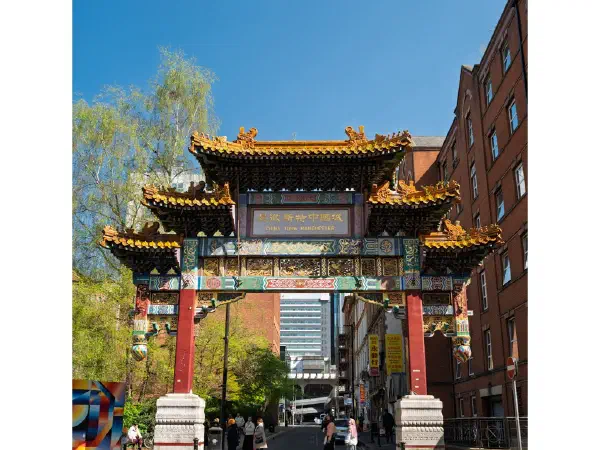
- Chinatown and Canal Street add colour and character a short walk south.
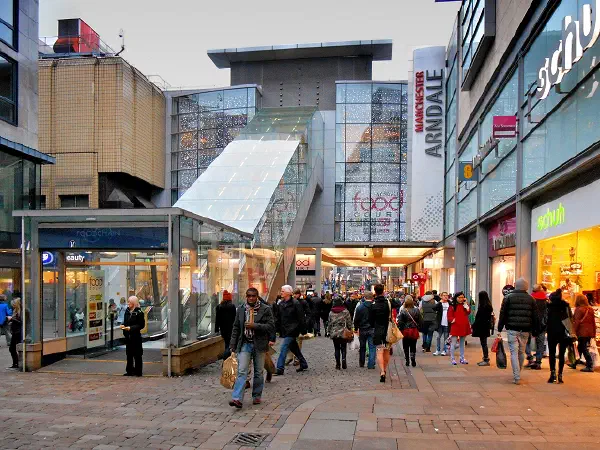
- Arndale Food Market is a strong indoor option when it rains.
- Browse all city-centre spots or plan a route on the map.
For the best light, see our golden hour and most Instagrammable spots guides.
How to shoot it
Lens
A 24–70mm covers most scenes; a 70–200mm isolates detail and a macro lens finds the small stuff.
Settings
f/5.6–f/8 for natural depth, low ISO, and a polariser to cut glare and deepen foliage and sky.
Composition
Use paths and tree lines as leading lines, add foreground interest, and shoot into low side-light for depth and texture.
Timing
Aim for golden hour — the hour after sunrise or before sunset — when low, warm light rakes across the scene. Today's exact window is in the panel on this page.
More in City Centre
See the area →Nearby spots
Shooting the whole area? Read the City Centre photography guide — every spot, the light that suits it, and a route to link them.