 Blue hour
Best at blue hour
Spinningfields
Spinningfields · ManchesterSome gear links on this page are affiliate links — if you buy through them we may earn a small commission at no extra cost to you. See our affiliate disclosure.
What is Spinningfields?
Spinningfields is Manchester’s purpose-built central business district, developed in the 2000s by Allied London as part of the city’s post-1996 regeneration plan. It sits west of Deansgate, bounded by the River Irwell, Bridge Street and Quay Street, and replaced a tired industrial fringe with one of the densest clusters of contemporary architecture in the North of England.
The district packs around 20 buildings and over three million square feet into a compact, walkable grid. The standouts for photographers are the Manchester Civil Justice Centre — nicknamed the “filing cabinet” for its stacked, cantilevered floors — the 92 m glass tower of No. 1 Spinningfields, and The Avenue, whose diagonal steel diagrid cantilever hangs dramatically over the pedestrian route below. Between the towers you get Hardman Square, a landscaped lawn that opens up clean sightlines, plus riverside walkways, alfresco dining terraces and a constant flow of foot traffic.
Because everything was masterplanned rather than accumulated over centuries, the area has an unusually coherent look — polished stone paving, full-height glazing, repeated geometric motifs. That consistency is exactly what makes it such a productive patch for modern architectural photography: you can fill a memory card without walking more than ten minutes.
Why Shoot Here?
- Contemporary architecture: Slick glass towers, angular façades and cantilevered structures give you bold, graphic subjects in every direction.
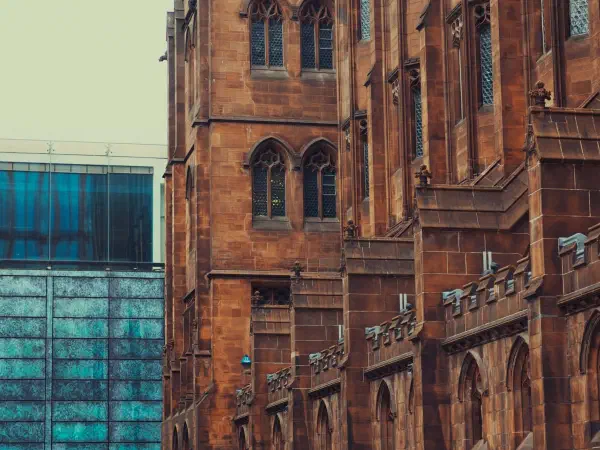
- Urban contrast: The Victorian gothic of the John Rylands Library sits literally across the road on Deansgate — you can juxtapose 1890s sandstone against 21st-century glass within a single frame, or shoot both in one short session.
- Reflections and light: The glass façades bounce light around all day. At sunrise the east-facing glazing glows; at blue hour the lit lobbies and bar frontages turn every surface into a layered light show; after rain the stone paving becomes a mirror.
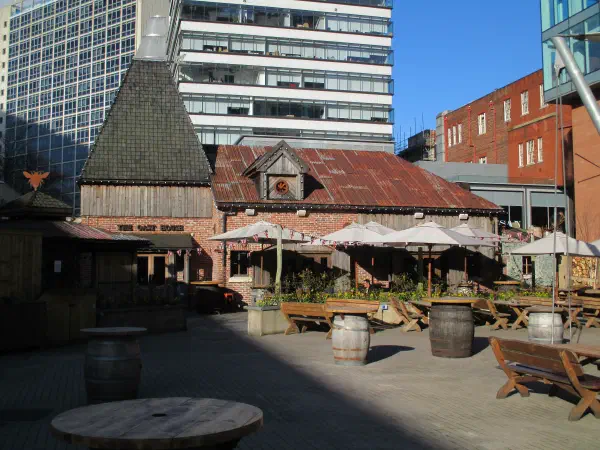
- Street life: Weekday lunchtimes fill Hardman Square with office workers and diners — strong material for candid street photography against graphic backdrops. The Oast House, the timber-framed pub marooned among the towers, adds a surreal old-meets-new focal point.
- All-weather reliability: Overcast skies suit the monochrome geometry here, and the covered walkways and colonnades let you keep shooting in drizzle.
- Easy to combine: The district is the natural endpoint of the Medieval Quarter to Spinningfields walk, which strings together the cathedral area, Deansgate and the modern district in one route.
Getting There
The nearest tram stops are Deansgate-Castlefield and St Peter’s Square, both roughly a 5-minute walk away. From St Peter’s Square, head down John Dalton Street, cross Deansgate and you’re in the district; from Deansgate-Castlefield, walk north up Deansgate and turn left at Quay Street. On foot from Albert Square and the Town Hall it’s under ten minutes — aim for the John Rylands Library on Deansgate and the glass towers rise directly behind it. Drivers should use NCP Spinningfields (around £8–12 per day); early-morning weekend arrivals will find it quietest.
Photography FAQ
Is Spinningfields free to visit?
Yes — it’s a publicly accessible district with no entry fee and no closing time, so sunrise and late-night shoots are straightforward. The squares, walkways and riverside paths are all open to pedestrians around the clock.
Can you use a tripod in Spinningfields?
Generally yes on the streets and in Hardman Square, but this is a managed commercial estate, so security may occasionally ask what you’re doing — especially close to building entrances. A polite explanation almost always settles it; keep walkways clear at busy times.
Can you fly a drone in Spinningfields?
Realistically, no. This is dense city-centre airspace with crowds, and CAA rules prohibit flying over uninvolved people with most drones — city-centre flying in Manchester is heavily restricted. Check the CAA’s Drone Code and an airspace app before even considering it; ground-level wide-angles are the practical option here.
What lens should I bring to Spinningfields?
An ultra-wide (14–20 mm) for looking up at the cantilevers and a 70–200 mm for isolating façade patterns cover most of it. If you carry one lens, a 24–70 mm handles the squares, street scenes and architectural details adequately.
When is Spinningfields quietest for photography?
Early weekend mornings — before about 9 am on a Saturday or Sunday the squares are nearly empty, giving you clean architectural frames without waiting for gaps in the crowd. Weekday lunchtimes are the opposite extreme, which is exactly what you want for street work.
Further Information
- Wikipedia – Spinningfields — overview of its development, buildings, and regeneration history
- Wikipedia – Manchester Civil Justice Centre — architecture and significance of the landmark “filing cabinet” building
- Wikipedia – No. 1 Spinningfields — details on the 92 m office tower and its planning history
- Visit Manchester – Spinningfields — leisure amenities, dining, and urban life in the district
Best Times to Shoot
- Sunrise is the prime slot — the glass façades of No. 1 Spinningfields and The Avenue catch the first eastern light and glow orange-gold while the streets are still quiet and shadow-filled.
- Blue hour transforms the district into a showcase of reflected artificial light: lit lobbies, street lamps and bar frontages all layer across the glass. The 20–30 minutes after sunset, when the sky still holds deep blue, is the sweet spot.
- Weekday lunchtimes fill Hardman Square with office workers, alfresco diners and constant movement — ideal for street photography with hard midday light bouncing between the façades.
- After rain the polished stone paving acts as a mirror, doubling the height of the towers. Overcast, freshly wet conditions here often out-perform clear skies — get low to the ground and the reflections do the work.
Composition Ideas
- Shoot the Civil Justice Centre from directly below at its narrowest point, using a 16 mm ultra-wide to exaggerate the cantilevered overhang and make the building loom overhead.
- Stand in the centre of Hardman Square and use the geometric paving lines to lead toward No. 1 Spinningfields, placing a single figure in the midground for scale.
- Frame the steel diagrid of The Avenue as an abstract fill-the-frame shot — a telephoto like the 70–200 mm isolates the repeating diamond pattern against the sky.
- Walk the River Irwell bank at the western edge and shoot back toward the Spinningfields skyline for a layered cityscape with water in the foreground.
- Use the Oast House’s timber gables as a foreground anchor with glass towers rising behind — the period-against-modern contrast carries the frame on even a flat grey day.
How to shoot it
Lens
A 16–35mm wide exaggerates scale and verticals; a 24–70mm keeps proportions natural. A tilt-shift tames converging lines.
Settings
f/8–f/11 for front-to-back sharpness, ISO 100, and meter for the highlights so detail in the stonework holds.
Composition
Hunt for symmetry and repetition, keep verticals straight, and use doorways or arches to frame the subject.
Timing
Blue hour — the ~20 minutes after sunset — is the sweet spot: the sky balances with the city's lights. Be set up before it starts; today's window is on this page.
More in Spinningfields
See the area →