 Any / overcast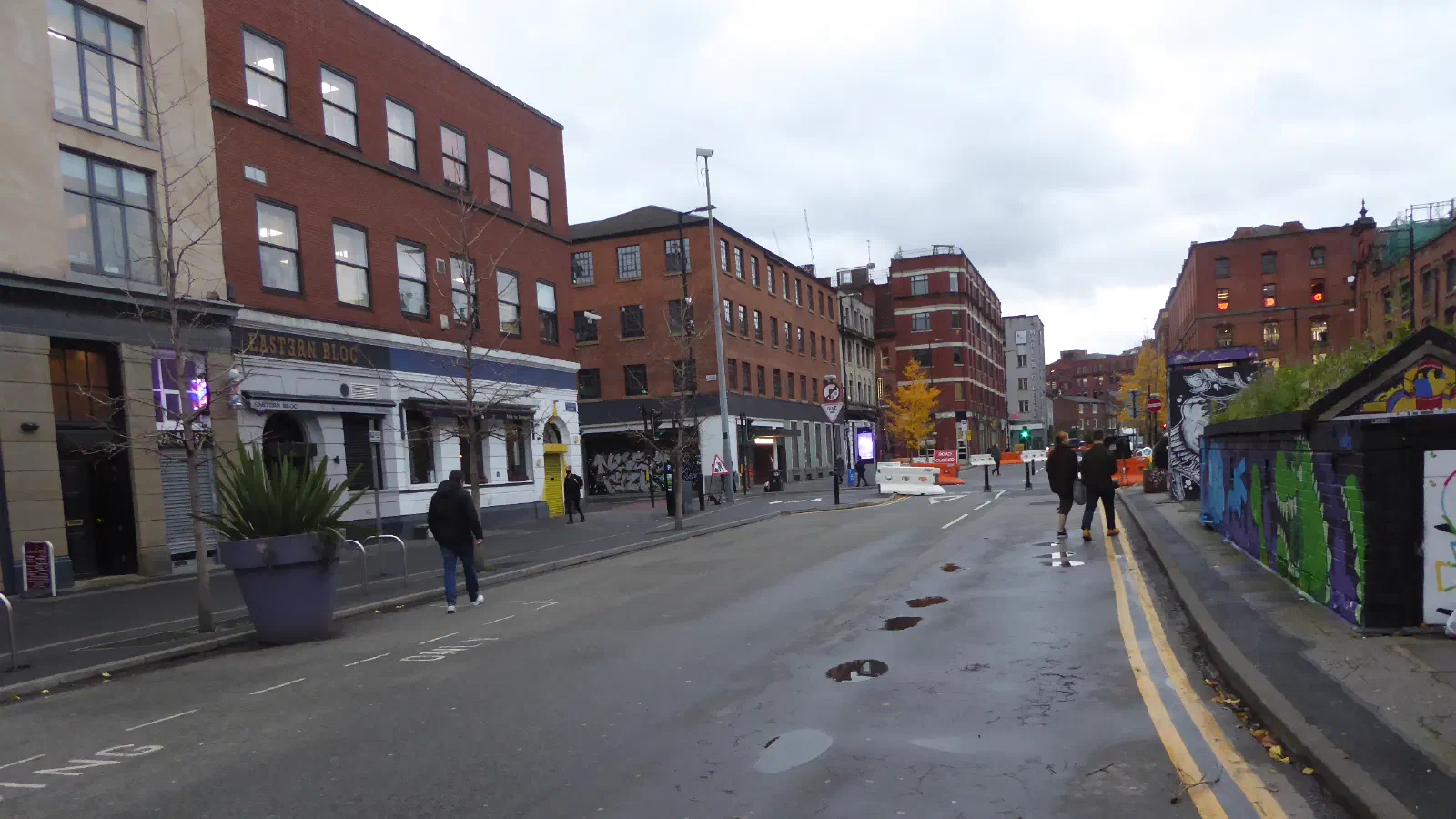
Best at any / overcast
Stevenson Square
Northern Quarter · ManchesterSome gear links on this page are affiliate links — if you buy through them we may earn a small commission at no extra cost to you. See our affiliate disclosure.
What is Stevenson Square?
Stevenson Square — commonly misspelled Stephenson Square, though every street plate and map gives it the first way — is the open heart of Manchester’s Northern Quarter. It was laid out in the 1780s by developer William Stevenson as a speculative residential square intended to rival the gentility of St Ann’s Square. The genteel plan never took: by the early 19th century the surrounding plots had filled with cotton warehouses and workshops, and the square spent much of the 20th century as a bus terminus.
Today it’s the Northern Quarter’s open-air gallery. The centrepiece is the Outhouse MCR project, which turns the square’s former public toilet block — plus surrounding hoardings, road surfaces and even redundant road signs — into a rotating canvas, repainted by local and international artists roughly every three months. The site famously hosted Akse’s portrait of David Bowie after the singer’s death in 2016; whatever is on the walls when you visit, it won’t be there for long, which is exactly why locals keep coming back with a camera.
The square sits where Lever Street and Hilton Street cross, ringed by independent cafés, bars and red-brick warehouse conversions. It isn’t a square in the formal sense — traffic still passes through part of it — but it’s the clearest expression of the Northern Quarter’s creative identity, and a natural anchor point on any Northern Quarter street photography walk.
Why Shoot Here?
Stevenson Square rewards photographers looking for urban character:
- Street art that changes: Because Outhouse repaints the square every few months, it’s one of the few Manchester locations you can shoot repeatedly and never get the same picture twice. Photograph what’s there now — it’s a record, not just a snap.
- Candid street photography: The benches, café terraces and constant foot traffic between Piccadilly and the Northern Quarter’s core create reliable opportunities for candid work. Pitch up with a fast 35mm prime — the Sony FE 35mm f/1.8 , Canon RF 35mm f/1.8 Macro IS STM , NIKKOR Z 35mm f/1.8 S , or the Fujifilm XF 23mm f/2 R WR on Fujifilm X — and wait.
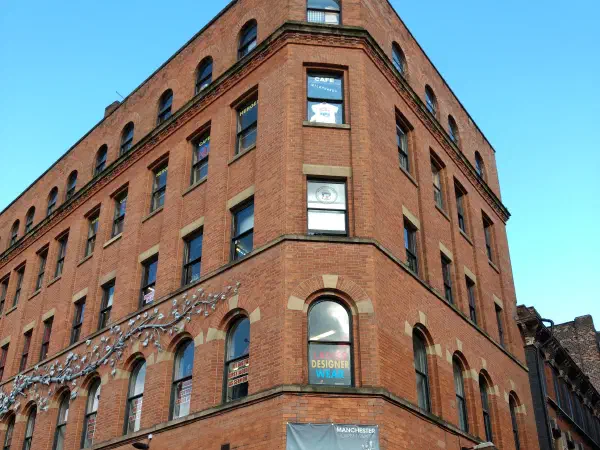
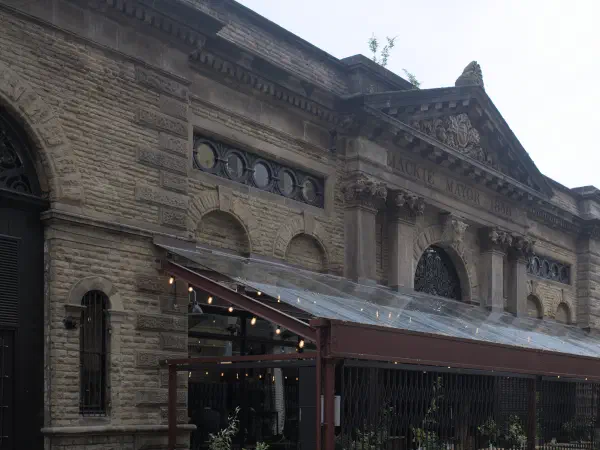
- Historic-meets-modern: Georgian and Victorian warehouse facades along Lever Street frame the contemporary art below — shoot wide to get both eras in one frame.
- A dense surrounding patch: Thomas Street, Tib Street and Afflecks are all within three minutes’ walk, so the square works as a hub for a longer session.
Getting There
From Piccadilly Gardens tram stop it’s a 3-minute walk: head up Oldham Street past the shops, turn right onto Hilton Street and the square opens up in front of you. From Manchester Piccadilly station, allow 8–10 minutes via Dale Street and Lever Street. Drivers should use NCP Shudehill (around £6–10 for the day), five minutes’ walk north-west — on-street parking in the Northern Quarter is scarce and heavily enforced. The square itself is open and free at all times.
Photography FAQ
Where is the street art in Stevenson Square?
The main canvas is the former public toilet block in the middle of the square, managed by the Outhouse MCR project. Artworks also spill onto nearby walls, shutters and road signs, with more murals along Tib Street and Thomas Street a short walk away.
How often does the street art change?
The Outhouse site is repainted roughly every three months, with individual pieces sometimes changing faster. If you see a mural you like, shoot it that day — there’s no guarantee it will survive the next rotation.
Is street photography legal in the Northern Quarter?
Yes. The square and surrounding streets are public space, so photographing people going about their day is legal in the UK. Be courteous around café terraces, and if someone objects, the polite move is simply to delete and move on.
When is Stevenson Square quietest?
Early weekend mornings (before 9am) are best for clean, people-free mural shots. By lunchtime the cafés and benches fill up, which suits candid work better; the street photography guide to Manchester covers how to work the busier hours.
Further Information
- Manchester City Council — Stevenson Square Conservation Area — history of the square’s 1780s origins and development
- Manchester’s Finest — Stevenson Square through the years — illustrated history from wasteland to creative hub
Best Times to Shoot
- Morning (before 10am): The square is quieter and murals are evenly lit without harsh shadows — ideal for clean street art documentation before the delivery vans and café crowds arrive.
- Golden hour: Late afternoon sun rakes down Hilton Street, casting warm tones across the red-brick warehouse walls and lifting the saturation of painted surfaces.
- Evening: Neon signage and bar lighting around Lever Street create atmospheric backdrops for portraits and night street photography; the square stays lively well after dark on weekends.
- Overcast days: Flat, diffused light reduces glare on glossy paint and keeps colours true across the murals — arguably the best conditions for straight-on artwork records.
Composition Ideas
- Use a wide-angle lens (24–35 mm) to capture full murals with the surrounding streetscape — including the warehouse architecture above gives the art context and a sense of place.
- Shoot portraits with the Outhouse murals as colourful, textured backdrops; step back and shoot at 50–85 mm to compress subject and artwork together.
- Frame candid moments through café windows on the square, layering reflections of the murals with interior activity for storytelling images.
- Look for repeating patterns in doorways, shutters and painted road signs for graphic, symmetrical compositions — then work outwards along Tib Street, where the artwork continues.
How to shoot it
Lens
A 35mm or 50mm prime is ideal — small, fast and unobtrusive for candid frames and shopfront detail.
Settings
Shutter priority at 1/250s or faster to freeze movement, with Auto ISO so you can keep shooting as the light shifts.
Composition
Work the light and shadow, look for layers and gesture, and let strong shopfront colour or signage carry the frame.
Timing
Bright overcast suits it best — soft, even light with no harsh shadows — so it works at almost any time of day.
More in Northern Quarter
See the area →Nearby spots
Shooting the whole area? Read the Northern Quarter photography guide — every spot, the light that suits it, and a route to link them.