 Blue hour
Best at blue hour
The Elizabeth Tower
New Jackson · ManchesterSome gear links on this page are affiliate links — if you buy through them we may earn a small commission at no extra cost to you. See our affiliate disclosure.
What is The Elizabeth Tower?
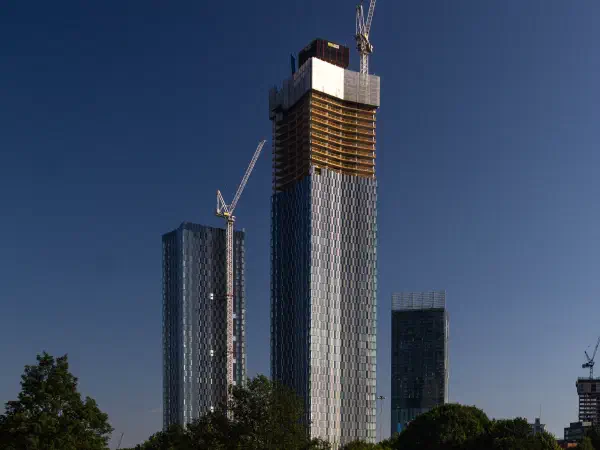
The Elizabeth Tower is a 52-storey, 153-metre residential skyscraper at Crown Street, off Great Jackson Street in Manchester’s New Jackson district — not to be confused with the Elizabeth Tower in London that houses Big Ben. This is the Manchester one: a sleek apartment tower completed in 2022, designed by SimpsonHaugh (the practice behind Beetham Tower) and built by Renaker as the centrepiece of the first phase of the Crown Street development. It contains 484 apartments and ranks among the tallest buildings in Greater Manchester.
It’s crowned with a rooftop garden and a much-photographed residents’ swimming pool — both private, so the interest for photographers is entirely exterior. And the exterior delivers: unlike the flat curtain-wall glass of the neighbouring Deansgate Square cluster, the Elizabeth Tower’s facade has a more textured, sculpted relief that catches and breaks light across the day. Standing slightly apart from the four Deansgate Square towers, it reads as a distinct vertical in skyline shots from Castlefield, the Bridgewater Canal and points south — and at street level it terminates several sightlines around Great Jackson Street, setting up strong symmetrical compositions.
Why Shoot Here?
- Elegant facade: The textured, stepped surface plays with light and shadow in a way the flatter glass towers nearby simply don’t — late sun turns it into a study in vertical relief.
- Urban symmetry: The tower’s position at the end of several street views around Crown Street and Great Jackson Street makes it a natural anchor for dead-centre, vanishing-point compositions.
- Night illumination: The crown of the tower is subtly lit after dark, making it easy to pick out in night-time skyline shots across the city.
- The New Jackson canyon: Its proximity to the Deansgate Square cluster sets up dramatic “canyon” shots — converging verticals of glass and texture shot from the pavements between the towers.
- Skyline anchor: From the Castlefield Viaduct and the canal towpaths, the tower is a key vertical in the southern skyline — one of the defining additions of Manchester’s 2020s high-rise boom.
Getting There
From Deansgate-Castlefield tram stop it’s a five-minute walk: exit onto Deansgate, head south past the Deansgate Locks arches, and turn into Great Jackson Street — the tower rises directly ahead at Crown Street. From Beetham Tower it’s barely three minutes on foot, which makes pairing the two SimpsonHaugh buildings in one session easy. The nearest parking is NCP Great Northern (~£8–12/day), about ten minutes’ walk north along Deansgate. The streets around the base are public and open at all hours.
Photography FAQ
Is the Elizabeth Tower in Manchester the same as Big Ben?
No. Big Ben’s clock tower at the Palace of Westminster is officially named the Elizabeth Tower, but this page is about a completely different building: a 52-storey residential skyscraper at Crown Street, Manchester, completed in 2022. Same name, 200 miles apart.
How tall is the Elizabeth Tower in Manchester?
It stands 153 metres (501 ft) over 52 storeys, making it one of the tallest buildings in Greater Manchester. Only the Deansgate Square towers and a handful of newer Renaker buildings in the same district top it.
Can you go up the Elizabeth Tower?
No — it’s a private residential building, and the rooftop garden and pool are for residents only. For an elevated view over this part of the skyline, see our guide to the best Manchester skyline viewpoints.
Where is the best place to photograph the Elizabeth Tower?
At street level, the pavements around Crown Street and Great Jackson Street give the canyon and symmetry shots; for context, shoot from the Bridgewater Canal towpath or the Castlefield basin, where the tower stacks against the Deansgate Square cluster with water in the foreground.
Is it safe to shoot there at night with a tripod?
Yes — the area is well lit, residential and busy enough to feel comfortable, and the public pavements allow tripods. Stay off the private podium areas at the base and you’ll have no issues.
Best Times to Shoot
- Golden hour (west-facing sides) — Late afternoon sun lights up the textured facade with warm tones and elongated shadows that emphasise the building’s vertical relief and surface detail.
- Blue hour — The subtle crown illumination glows against the deep blue sky, and the surrounding Deansgate Square towers add complementary light, making this the prime window for skyline shots from Castlefield or the canal.
- Clear mornings after rain — Wet streets and pavements around the base reflect the tower’s full height, and clean air sharpens the upper floors against the sky; puddles on Great Jackson Street are reliable reflection foregrounds.
- Night (match nights or events nearby) — When the Deansgate area is busy, light spill from surrounding venues adds ambient warmth and passing pedestrians provide human scale at street level.
- Low cloud days — At 153 m the top floors disappear into the cloud base several times a year; an upward shot of the tower vanishing into mist is a genuinely different image of a much-photographed building.
Composition Ideas
- Street-level canyon shot — Stand between The Elizabeth Tower and the Deansgate Square cluster, using a wide-angle lens (16–24 mm) aimed upward to capture the towers converging against the sky for a dramatic urban canyon effect.
- Symmetrical end-of-street framing — Find a street that terminates with the tower — the approaches off Great Jackson Street work well — and shoot dead centre with a 50 mm lens so the building anchors a strong vanishing-point composition.
- Facade texture detail — Use a 70–200 mm telephoto like the Sony 70-200mm f/4 G OSS from a distance to isolate sections of the facade where light and shadow play across the textured cladding, creating abstract architectural patterns; late afternoon gives the strongest relief.
- Reflection in neighbouring glass — Photograph the tower’s reflection in the curtain-wall glass of an adjacent Deansgate Square building for a distorted, artistic take on the skyline.
- Canal-side context — From the Castlefield canals or the Bridgewater towpath, frame the tower above the Victorian brick, ironwork and water of the basin — the contrast between 19th-century infrastructure and 2020s high-rise is the story of this whole quarter.
How to shoot it
Lens
Reach for a 70–200mm to compress the towers and stack the skyline; a 24–70mm covers wider establishing frames.
Settings
Tripod, f/8–f/11, ISO 100 and exposures of 1–10s to balance lit windows against the sky.
Composition
Find a clean foreground or reflective surface, place the tallest tower off-centre on a third, and layer near and far elements.
Timing
Blue hour — the ~20 minutes after sunset — is the sweet spot: the sky balances with the city's lights. Be set up before it starts; today's window is on this page.
More in New Jackson
See the area →Nearby spots
Blue hour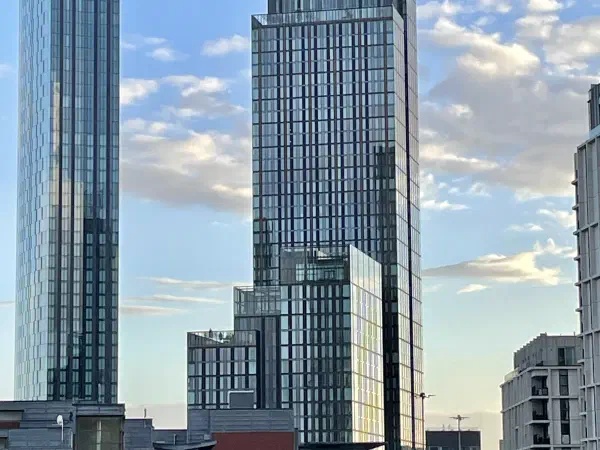 Golden hour