 Blue hour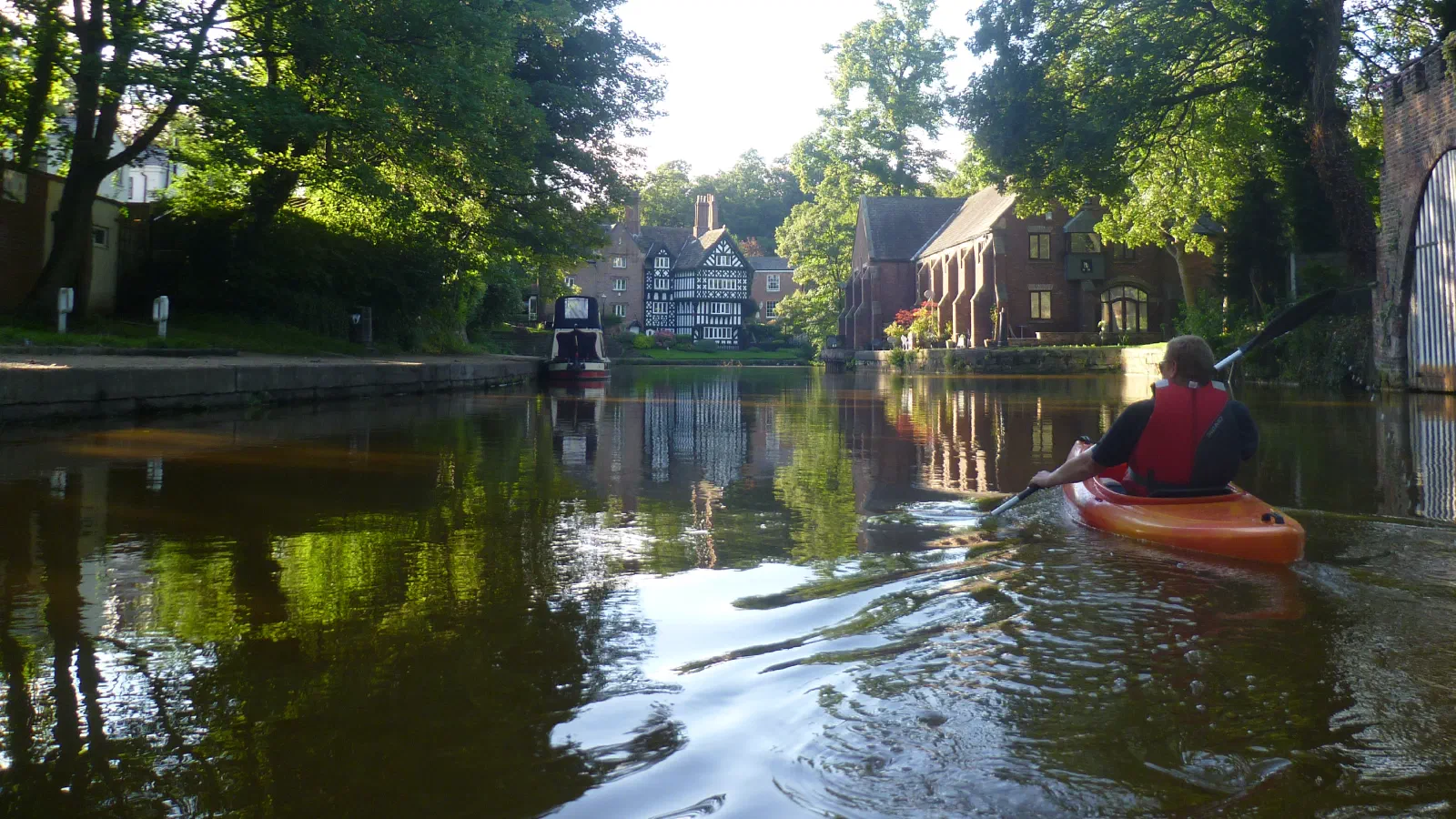
Best at any / overcast
Worsley Village
Salford · ManchesterWhat is Worsley Village?
Worsley Village is a conservation-area village in Salford with a claim to fame no other photography location in Greater Manchester can match: a canal that runs orange. This is the birthplace of the Bridgewater Canal, opened in 1761 for Francis Egerton, the Duke of Bridgewater, and engineered by James Brindley — widely regarded as Britain’s first true canal, built to carry coal from the Duke’s mines into Manchester.
The orange colour is iron oxide (ochre) washing out of those old mine workings. At Worsley Delph, a former sandstone quarry basin a short walk from the village green, two dark tunnel mouths mark the entrance to the underground “navigable levels” — a network of subterranean canals that ran for miles beneath the coalfield. Water still drains from the levels into the canal, staining it the rust colour that makes Worsley photographs look colour-graded straight out of camera. The intensity varies with rainfall and season, but the tint is always there.
Above the water, the village delivers the second half of the postcard: black-and-white timber-framed buildings, most famously the Packet House, whose striking half-timbered wing was added around 1850 for the Earl of Ellesmere. From its stone steps, passenger packet boats once departed for Manchester. Add the stone-and-iron bridges, the village green and the overhanging trees, and you have one of the most complete period scenes in the region.
Why Shoot Here?
- The orange canal: Rust-coloured water is a genuinely unique subject — it reads as warm foreground colour in every composition and contrasts vividly with green banks, white render and black timber.
- The Packet House: The definitive Worsley subject — a tall, gabled, mock-Tudor frontage rising straight from the canal edge, with steps down to the water and a near-perfect reflection on still mornings.
- Worsley Delph: The quarry basin and tunnel entrances are atmospheric, historically loaded and rarely photographed well — shaded, dark water against sandstone cliffs, with an interpretive viewing platform.
- Bridges and framing: Several low stone and iron bridges cross the canal within a few hundred metres, each offering arches to frame through and parapets to shoot from.
- Compact and walkable: Green, Delph, Packet House and towpath all sit within a five-minute radius.
Getting There
Worsley is easiest by car: the village sits just off junction 13 of the M60, and there’s a free car park off Barton Road a couple of minutes’ walk from the green. By public transport, the 34 bus from Manchester Piccadilly Gardens takes about 40 minutes. From the car park, walk towards the village green and the canal is immediately ahead — the Packet House stands where Barton Road meets the water, and Worsley Delph is signposted a few minutes along the path on the opposite side of the road bridge.
Photography FAQ
Why is the water orange in Worsley?
Iron oxide — ochre — drains out of the old underground coal workings at Worsley Delph and stains the Bridgewater Canal a rust-orange colour. It’s a permanent feature, though the intensity shifts with rainfall and flow.
What is Worsley Village famous for?
Two things: the orange water of the Bridgewater Canal, coloured by iron ore from the mines, and its black-and-white timber-framed buildings, especially the Packet House. It’s also where Britain’s first true canal opened in 1761, making it a key site of the Industrial Revolution.
Can you walk the canal towpath at Worsley?
Yes — the towpath is public and runs through the village in both directions, eastward ultimately connecting towards Manchester and the Castlefield canal basin where the Bridgewater ends. The Barton Swing Bridge, another canal-engineering landmark, is a short drive away.
Is the Packet House open to the public?
No — it’s privately occupied, so treat it as an exterior subject only. The best views are from the public towpath and the bridge directly opposite; there’s no need to leave public land for any of the classic compositions.
When does Worsley look its best?
Autumn. The orange water doubled with amber foliage is unique in Greater Manchester, and the village features on most local autumn photography lists. Failing that, a still early morning in any season for reflections.
Further Information
- Pennine Waterways – Worsley Delph and the underground canals — the navigable levels and the Delph basin
- Wikipedia – Bridgewater Canal — history of Britain’s first true canal
- Wikipedia – Worsley — the village, its buildings and mining heritage
Best Times to Shoot
- Autumn (October–November) — Worsley’s combination of rust-orange canal water and autumn-coloured trees produces a double-warmth palette unique in Greater Manchester: the water reflects the amber and russet of the overhanging trees, a scene that looks artificially graded but is entirely real.
- Early morning (before 9:00) — The canal is at its stillest before boat traffic arrives. The Packet House and the timber-framed buildings reflect cleanly in the calm orange water, and the towpaths are quiet apart from dog walkers.
- Overcast days — Direct sun creates harsh contrast on the black-and-white facades; the dark beams need flat light to hold detail alongside the whitewashed panels. The orange water keeps its colour regardless of sun angle, so nothing is lost on a grey day.
- Spring and early summer — Fresh green growth along the banks against the orange water is a striking complementary pairing, and the iron staining is just as strong as in autumn.
Composition Ideas
- Packet House and orange canal from the bank — Stand on the bank directly opposite the Packet House with a 35–50 mm lens and frame the timber-framed building above its orange reflection. Centre the waterline for symmetry, or drop it to the lower third to emphasise the reflection. This is the definitive Worsley shot.
- Through the bridge arch toward the village — The bridges are low enough that their arches frame the canal from near water level. Crouch with a 24–35 mm lens and shoot through an arch towards the Packet House, letting the arch contain the warm water and timber frontage.
- The Delph tunnel mouths — From the viewing area at Worsley Delph, a 35–70 mm lens isolates the dark tunnel entrances against the sandstone, with the orange-stained water in the foreground. Bracket exposures — the shaded basin runs several stops darker than open sky.
- Orange water abstract — Get close to the surface with a 50–85 mm lens at f/4–f/5.6 and photograph the water itself: ripples, vegetation reflections, texture. Exclude the banks entirely and the rust colour becomes a pure abstract found nowhere else on the Manchester canal network.
- Towpath leading line — Walk a few hundred metres out and shoot back towards the village at 35–70 mm: orange water in the foreground, the Packet House in the mid-distance, towpath vegetation framing the edges.
How to shoot it
Lens
A 16–35mm wide takes in reflections and foreground; switch to a 70–200mm to compress distant detail across the water.
Settings
Tripod, f/11, ISO 100 and a 1–8s exposure for glassy water and clean reflections; an ND filter extends it in daylight.
Composition
Shoot low to maximise the reflection, use the waterline as a leading line, and wait for still water to double the scene.
Timing
Bright overcast suits it best — soft, even light with no harsh shadows — so it works at almost any time of day.
More in Salford
See the area →Nearby spots
Shooting the whole area? Read the Salford photography guide — every spot, the light that suits it, and a route to link them.